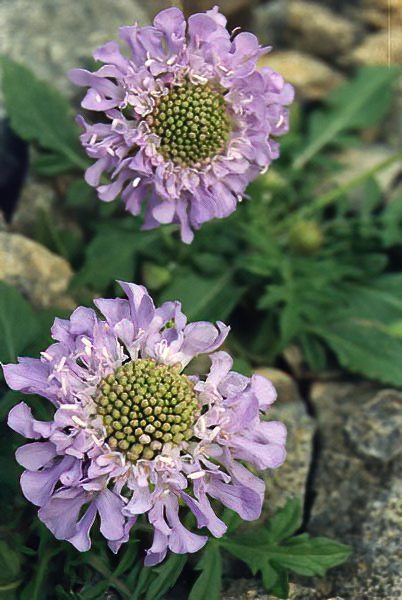
Perennial of the Caprifoliaceae family (formerly Dipsacaceae), Scabiosa cinerea is native to Mediterranean and sub-Mediterranean regions, mainly from central and southern Italy, as well as the western Balkans, where it colonizes limestone rocks, dry lawns, and sunny screes, often between 300 and 1,500 meters in altitude.
It forms a low and compact tuft, slightly bushy at the base, generally reaching 20 to 40 cm in height when in bloom. The foliage is its most immediately recognizable feature: the basal leaves are finely cut, of a silvery gray-green, almost ashen, which directly refers to the epithet cinerea. This persistent, very cut foliage gives the plant a vaporous, almost woolly texture.
The flowers are gathered in solitary capitula borne by long slender stems, of pale lavender to soft lilac color, with larger ligulate flowers on the periphery that give the whole a characteristic lightness.
In its natural habitat, its flowering extends from June to August. In cultivation, it can bloom from May to September depending on exposure.
It requires well-drained soil, poor to moderately fertile, in full sun; it dreads stagnant winter humidity. Perfectly suited for rock gardens and limestone walls.