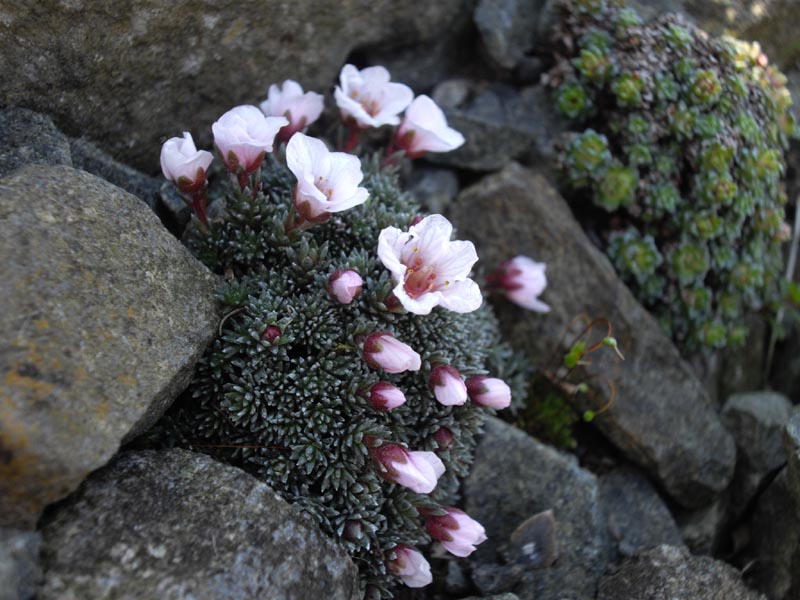
Evergreen perennial of the Saxifragaceae family, this cultivar belongs to the hybrid group × irvingii, resulting from the cross between Saxifraga burseriana, from the Eastern Alps and the Balkans, and Saxifraga lilacina, native to the Himalayas. 'Walter Irving' was obtained at the Royal Botanic Gardens, Kew, and its name was long used as a synonym for the entire hybrid group before the name × irvingii was applied more broadly. The RHS awarded it the Award of Garden Merit, recognizing its value and reliability in cultivation.
The plant forms a low, neat, and tight cushion, composed of dense rosettes with small, short leaves, dark green to grayish-green, slightly lime-bearing. The habit is more compact and more regular than that of 'Jenkinsiae', with which it is often compared, and to which it bears a strong resemblance in flower. The buds are a bright carmine pink, contrasting with the dark foliage before opening.
The flowers are solitary, borne on short stems 2 to 4 cm, a very pale pink almost white, with broad and rounded petals 8 to 12 mm, with a slightly pinkish center. The flowering, generous although slightly less abundant than that of 'Jenkinsiae' according to specialized authors, occurs in cultivation from February to April.
Like the other Kabschia hybrids of this group, 'Walter Irving' is traditionally grown in a pot or under a cold frame, in a very well-drained, calcareous substrate, sheltered from excessive winter moisture. It can tolerate light partial shade in summer.