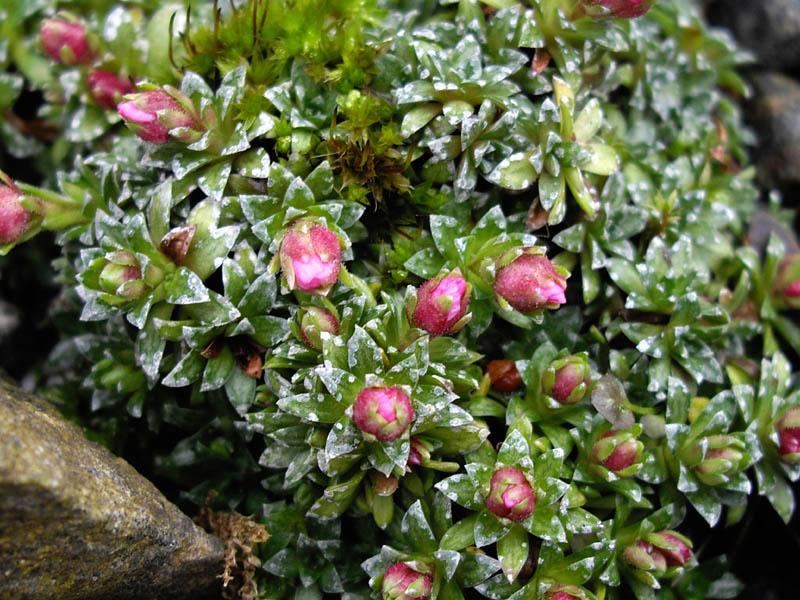
Evergreen perennial of the Saxifragaceae family, this cultivar belongs to the hybrid group × irvingii, resulting from the cross between Saxifraga burseriana, a species from the Eastern Alps and the Balkans, and Saxifraga lilacina, native to the Himalayas. It was obtained by a nurseryman named Jenkins, whose surname is thus preserved in the name of the cultivar. Considered by specialists as one of the best hybrids of the Porphyrion section, 'Jenkinsiae' has established itself as a reference in alpine collections for over a century.
The plant forms dense and vigorous mounds of medium rosettes, composed of five to eight short-pointed, glaucous green leaves, slightly calciferous at the edges. The floral buds, of a deep carmine pink, contrast sharply with the foliage before anthesis, offering a spectacle as remarkable as the flowers themselves.
The flowers are solitary, borne on stems 2 to 4 cm tall, of a very pale pink almost white, with wide and rounded petals measuring 9 to 12 mm, with a slightly tinted center. The flowering is abundant and regular. In cultivation, it generally occurs from February to April depending on exposure and altitude.
Like most demanding Kabschia hybrids, 'Jenkinsiae' is traditionally grown in pots or containers under a cold frame, sheltered from prolonged winter rains, in a very drained and calcareous substrate. It can succeed in a well-exposed rock garden provided that water stagnation is rigorously avoided.