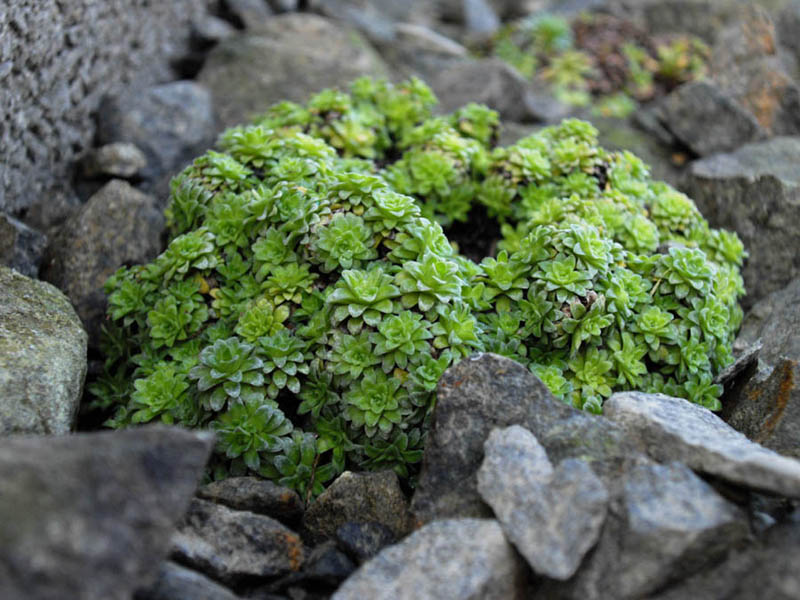
Evergreen perennial from the Saxifragaceae family, this cultivar is a garden hybrid obtained by R. V. Prichard in 1925, resulting from a cross between Saxifraga aretioides, Saxifraga lilacina, and Saxifraga media. It belongs to the group of saxifrages from the Porphyrion section, these tight cushion hybrids that alpine plant enthusiasts cultivate with particular care. Its group name, × anglica, includes several cultivars resulting from complex crosses between species of this section.
The plant forms a very dense and regular cushion, composed of tiny imbricated rosettes with oval to spatulate leaves, glaucous green to medium green, slightly glandular to the touch. The cushion remains remarkably compact, barely exceeding 5 to 8 cm in height, and expands very slowly over the years into a firm and tight surface.
In spring, short floral stems bear flowers of a strong pink, with rounded and well-formed petals, which open directly at the cushion level or slightly above. In cultivation, flowering generally occurs from March to April depending on exposure. The bright pink color of the flowers stands out sharply against the dense green foliage.
Like most hybrids of this section, 'Beryl' is traditionally cultivated in a pot or container under a cold frame, sheltered from excessive winter rains, in a very drained substrate, rich in calcareous granules. It can also thrive in a well-exposed rock garden provided that stagnant moisture is rigorously avoided.