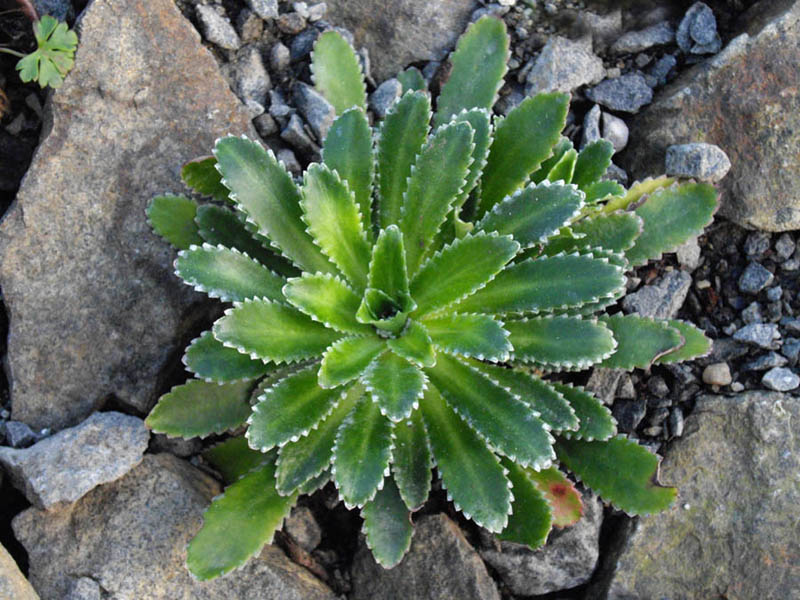
Perennial hybrid of the Saxifragaceae family, Saxifraga x andrewsii is a natural cross between Saxifraga callosa and Saxifraga umbrosa, which appeared in Ireland in the 19th century and was described by Harvey. It belongs to the Ligulatae section through one of its parents, giving it this characteristic foliage, immediately recognizable among rock garden saxifrages.
The plant forms large, dense, and spreading rosettes, with elongated, spatulate, leathery, dark green, and shiny leaves, whose strongly toothed margin is highlighted by a fine white border formed by calcareous deposits. This detail distinguishes it at first glance. The rosettes organize into vigorous clumps that can exceed 30 cm in diameter. The foliage can take on reddish to wine-red hues in the cold season or in very exposed situations, offering a striking contrast with the white border of the margins.
In spring, reddish flower stems rise to 25-40 cm and bear branched panicles of small white flowers dotted with red. In its natural habitat and in cultivation, flowering extends from May to June.
Hardy and accommodating, it appreciates well-drained soil, preferably calcareous, in full sun to partial shade. It is perfectly suited to walls, rock gardens, and compositions between rocks, where its architectural foliage remains decorative all year round.