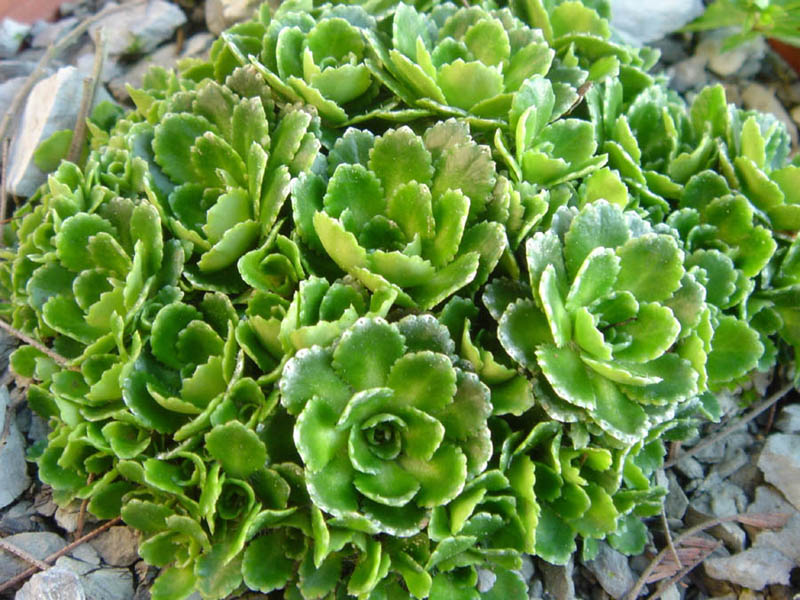
Evergreen perennial hybrid from the Saxifragaceae family, the parental origin of 'Winifred Bevington' is not established with certainty in the available sources. Two hypotheses are put forward according to the references consulted: a cross between Saxifraga callosa and Saxifraga umbrosa, or a hybrid resulting from Saxifraga umbrosa and Saxifraga spathularis, which would then bring it closer to Saxifraga × urbium. It is precisely the foliage that maintains the doubt: the plant has the general habit and panicle of an umbrosa, but its spatulate leaves bear on their crenellated margin a fine white border formed by calcareous deposits, a characteristic that rather evokes the influence of a parent from the Ligulatae section like Saxifraga callosa.
The plant forms dense clumps of small, compact, persistent rosettes, which gradually spread into a very regular cushion, pleasant to observe even outside of flowering. The leaves are oval to spatulate, bright green, slightly fleshy.
In spring, fine reddish floral stems rise 20-30 cm above the foliage and bear airy, light, and very branched panicles, adorned with numerous small pinkish-white flowers with a pink heart, which give a vaporous and luminous appearance in full bloom. In cultivation, flowering generally occurs from May to June.
It tolerates light to partial shade, making it one of the few saxifrages adapted to the less sunny situations of the rock garden. It appreciates well-drained soil, fresh without excess stagnant winter moisture, and is suitable for both walls and compositions between rocks in shaded situations.
>