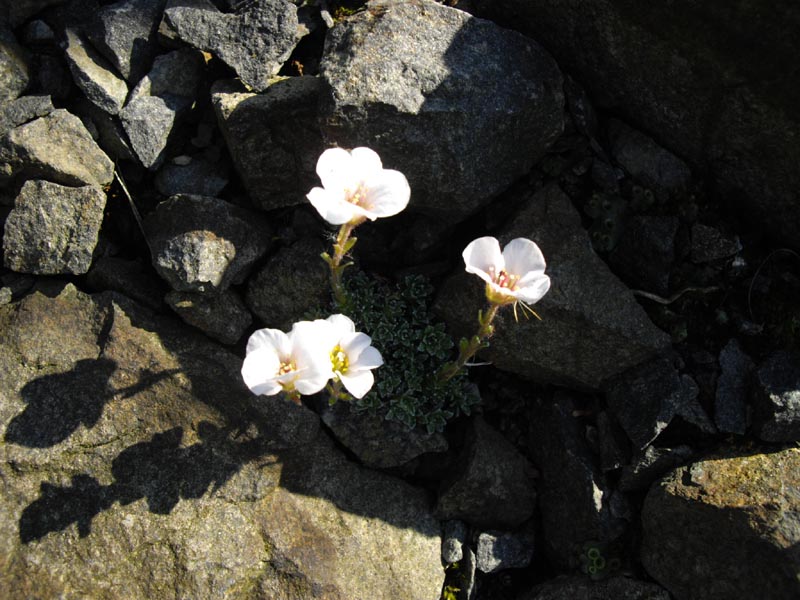
Perennial of the Saxifragaceae family, endemic to the southern Alps, mainly known from the Bergamasque Alps and the adjacent limestone massifs of northern Italy. It occupies the crevices of vertical or overhanging limestone cliffs, at altitudes generally between 1,200 and 2,200 meters.
It belongs to the Porophyllum section and forms small, dense, tight gray-green cushions, composed of rosettes of short, rigid leaves, bordered by a well-visible white calcareous encrustation that gives them a characteristic frosted appearance. This white edging, the result of calcareous secretion by the hydathodes, is one of the species' most distinct traits.
The flowers, large relative to the size of the plant, are borne on short stems of 3 to 8 cm, often solitary or in small numbers. They open pure white to slightly pink in bud, with a bright yellow center formed by the stamens and pistil. The flower buds, a deep red-purple before anthesis, contrast sharply with the whiteness of the open flowers.
In its natural habitat, its flowering extends from May to July depending on exposure and altitude. In cultivation, it generally blooms in April-May.
A demanding species, it requires cultivation in a vertical limestone rock crevice or in a pot under cold shelter, with absolute drainage and protection against winter moisture on the foliage. It is considered difficult outside of very well-controlled conditions.