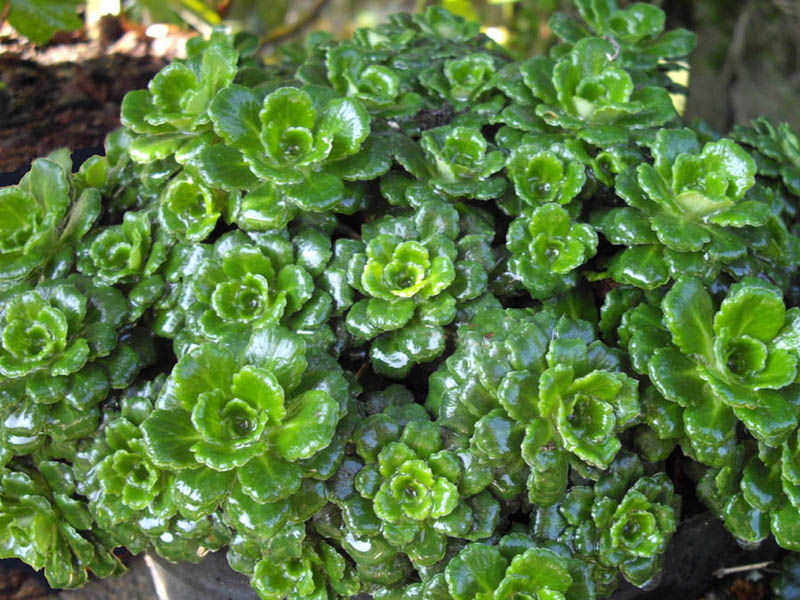
Perennial of the Saxifragaceae family, native to the Pyrenees, where it grows in cool undergrowth, shaded rock crevices, and stream banks, mainly between 600 and 2,000 meters altitude. Its name directly evokes its affinity for shady situations.
It forms dense carpets of flattened rosettes, composed of thick, leathery, glossy dark green leaves with crenate margins and short petioles. The foliage, evergreen, is particularly remarkable for its shiny and fleshy texture, clearly visible in the foliage photos. The rosettes multiply laterally to gradually cover large areas.
During flowering, slender, upright, reddish and glandular stems rise 20–30 cm above the foliage and bear light panicles of small white flowers with narrow petals, speckled with pink and yellow. The mass effect of these floral clouds against the backdrop of purple stems is of great delicacy.
In its natural habitat, its flowering extends from May to July. In cultivation, it generally blooms in May-June.
It should be noted that Saxifraga umbrosa is sometimes confused with Saxifraga × urbium, a very common garden hybrid; the two are similar but S. umbrosa has leaves with shorter petioles and a tighter rosette habit. It requires cool, humus-rich, well-drained soil, in shade or partial shade, without prolonged summer drought.