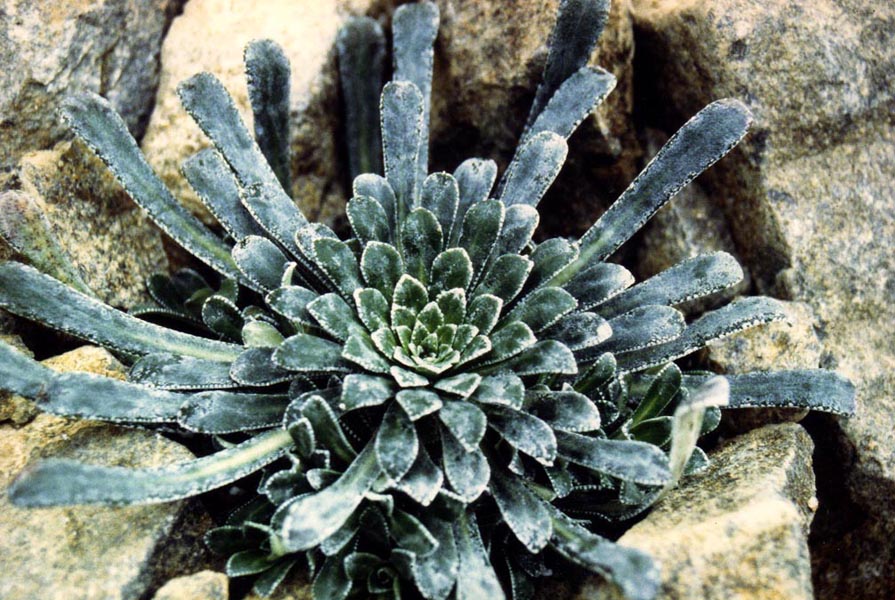
Perennial and evergreen hybrid of the Saxifragaceae family, 'Tumbling Waters' belongs to the Ligulatae section, the saxifrages with limestone-encrusted leaves, close to Saxifraga longifolia. It is sometimes marketed under the synonym Saxifraga longifolia 'Tumbling Waters'. This cultivar received the Award of Garden Merit from the Royal Horticultural Society, and was selected among the finalists of the Chelsea Plant of the Centenary in 2013 for the decade 1913-1922, a distinction that attests to its longevity and enduring reputation.
The plant forms large solitary, dense, and very regular rosettes, composed of long narrow, ribbon-like leaves, of a gray-silver green, edged with a fine white border formed by the limestone deposits secreted by the hydathodes. These rosettes, which can reach 30 cm in diameter, have a striking architectural character, particularly visible from above.
'Tumbling Waters' is monocarpic — each rosette blooms only once before dying, but produces lateral daughter rosettes that ensure the continuity of the clump. The floral stem can reach 60 to 70 cm and bears a long arched, highly branched panicle, covered with numerous white flowers about 10 mm. In cultivation, flowering occurs in spring, generally in April-May. Growth is slow, with the plant taking five to ten years to reach its full size.
It is cultivated in full sun, south or east exposure, in a limestone, poor and very well-drained substrate, in rock gardens or troughs.