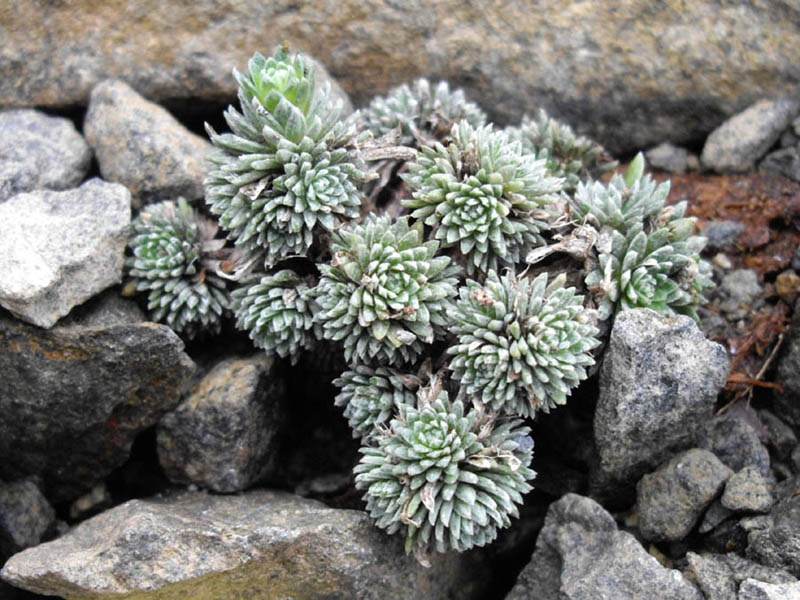
Perennial of the Saxifragaceae family, belonging to the Porophyllum section. The type species is native to the Balkans and western Anatolia, where it grows in high-altitude limestone rocks and screes. 'Afrodite' is a cultivar selected for the vigor and density of its foliage.
It forms a tight cushion of small compact rosettes, with narrow, linear, rigid, and densely silvery-gray leaves, covered with a fine silvery pubescence visible to the naked eye. The general appearance evokes, as the species name suggests, a miniaturized houseleek. The photo in natural conditions confirms this dense and flattened tufted habit, well anchored between the stones.
The floral stems, short and erect, are remarkably colored from their emergence, with a deep and velvety intense purple-violet, bearing bright pink to pink-purple flowers. This contrast between the silvery foliage and the almost black floral stems is striking and constitutes the main attraction of the cultivar.
In its natural habitat, the species blooms from May to July depending on the altitude. In cultivation, 'Afrodite' generally blooms in April-May.
It requires perfect drainage, a mineral limestone substrate, and full sun exposure. It proves robust and persistent once well-established, perfectly suited for troughs, rock gardens, and gravel gardens.