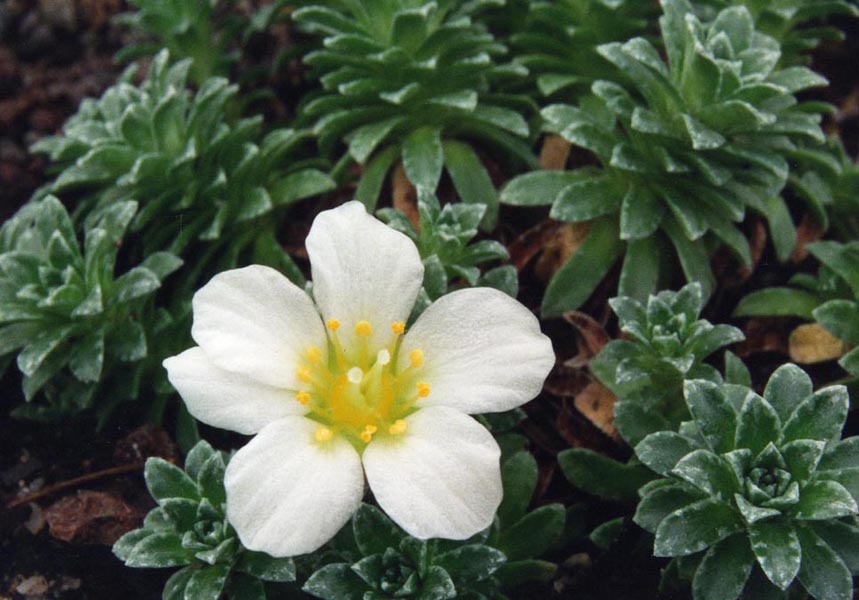
Perennial of the Saxifragaceae family, belonging to the Porophyllum section. Native to the Balkans and northern Greece, it has been observed notably on Mount Olympus, where it colonizes the walls and crevices of vertical or overhanging limestone rocks, at high altitudes.
It forms a very dense and compact cushion, insinuating itself into the slightest crevices of the rock. The rosettes, small and tight, are composed of narrow, rigid leaves with pointed tips, whose surface is characteristically encrusted with limestone, giving it a distinctly grayish to whitish appearance. This limestone deposit, exuded by hydathodes, is a distinctive feature of the Porophyllum section.
The floral stems, slender and reddish, 7 to 10 cm high, bear four to thirteen flowers with white to pale pink petals, which gradually turn cherry pink as they age. This color change throughout the flowering period is one of the most remarkable features of the species.
In its natural habitat, its flowering extends from April to June depending on the altitude. In cultivation, it generally blooms in April-May.
It requires perfect drainage, a limestone substrate, and a semi-shade or light shade exposure. It dreads stagnant moisture in winter and is more demanding than other saxifrages of its group. Cultivation in wall crevices or in an inclined trough suits it particularly well.