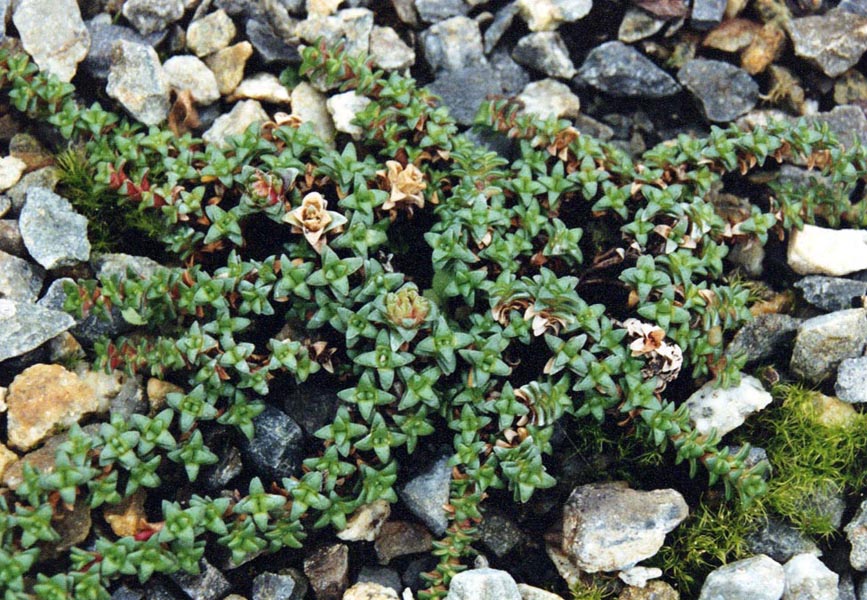
Perennial of the Saxifragaceae family, this species is distributed in the Pyrenees, the Alps, the northern Apennines, and the Carpathians. It belongs to the Porphyrion section and frequents siliceous rocks and scree at altitude, generally between 2,000 and 3,200 meters, in areas exposed to winds and subject to prolonged snow cover.
It forms creeping and dense mats, composed of very branched leafy stems bearing small oval to oblong leaves, obtuse at the apex, slightly fleshy, medium green to grayish-green, often tinged with reddish-brown on the edges and at the base in sunny conditions. This characteristic reddening of exposed leaves is one of the most recognizable traits of the species outside of flowering.
The flowers are pink to pink-purple, with five petals, borne by very short barely erect stems, usually two to five above the mat. They are small but of a strong color that contrasts sharply with the foliage.
In its natural habitat, its flowering extends from July to August depending on altitude and exposure. In cultivation, it generally occurs in May-June.
It requires a siliceous, very well-drained substrate, in full light, with moderate humidity in summer and good protection against stagnant moisture in winter. It is cultivated in troughs or acidic rock gardens and is more demanding than other cushion saxifrages regarding the nature of the substrate.