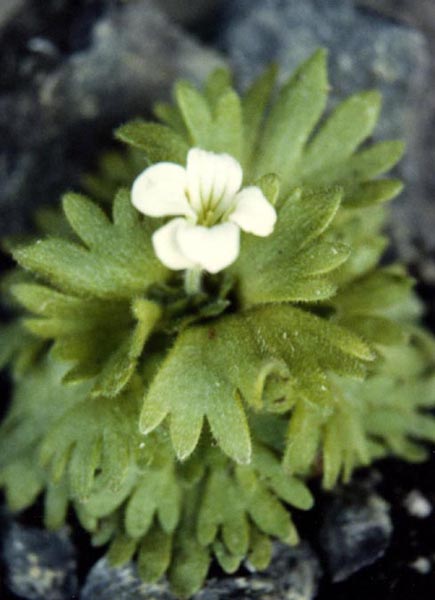
Perennial of the Saxifragaceae family, this subspecies is endemic to the southwestern Alps, mainly in the Maritime and Cottian Alps massifs, straddling the French-Italian border. It occupies rocks, cliffs, and siliceous or crystalline scree, generally between 1,800 and 3,000 meters in altitude.
It forms small, low, compact tufts with well-individualized rosettes. The foliage is one of the most immediately recognizable traits of the plant: the leaves are deeply dissected, with rounded and distinctly spatulate lobes, of medium green, and covered with a glandular pubescence that gives them a slightly sticky feel to the touch. This pronounced leaf dissection clearly distinguishes this subspecies from the encrusted saxifrages of the paniculata group.
The flowers are white, with oval petals bearing visible greenish veins, gathered in small, sparsely branched cymes above the foliage. The whole remains very close to the ground, with short flowering stems.
In its natural habitat, its flowering extends from July to August depending on the altitude.
In cultivation, it requires an acidic to neutral substrate, very well-drained, mineral, in a sunny to lightly shaded exposure, without stagnant winter moisture. It is suitable for cultivation in troughs or pots, on granitic or schistose substrate, and does not tolerate limestone.