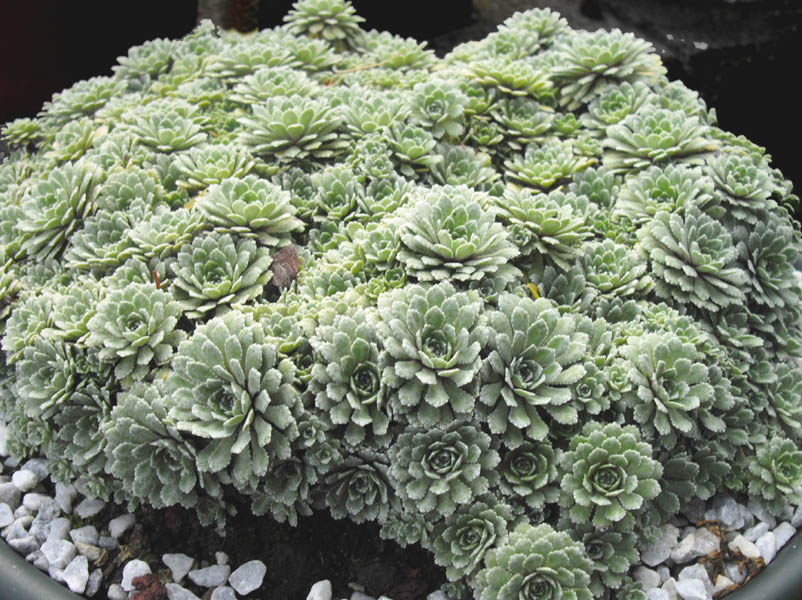
Perennial of the Saxifragaceae family, this cultivar is one of the oldest cultivated and most appreciated within the S. paniculata group. Its precise origin is not established with certainty, but it has long been present in specialized British and European collections, notably within alpine plant societies.
It forms dense, regular, and gradually domed cushions, composed of a multitude of small rosettes tightly packed against each other. The leaves are short, obovate to spatulate, medium green to gray-green, with a clear white calcareous encrustation edging each leaf and giving the entire cushion a particularly homogeneous frosted-silver appearance. It is precisely this regularity and density of the mat, which can form with time into compact domes of beautiful size, that distinguishes 'Whitehill' among the cultivars of the group.
The flowers are white, borne on slender stems above the foliage, in light panicles characteristic of the species.
In its natural habitat, S. paniculata blooms from June to August depending on altitude. In cultivation, flowering generally occurs in May-June.
It requires a very well-drained, mineral substrate, preferably calcareous, in full light, without stagnant winter moisture. Excellent in troughs, rock gardens, or elevated pots, where the domed shape of the cushion can develop freely and be fully appreciated.