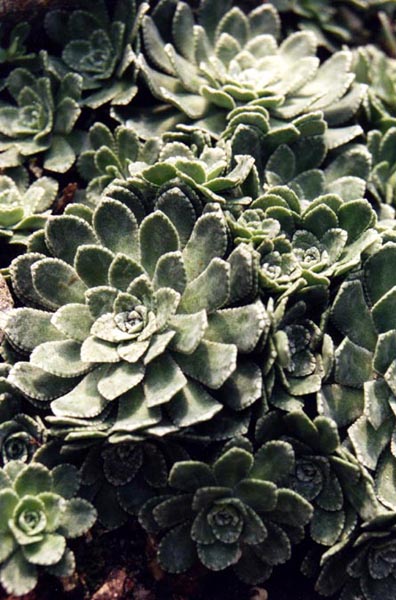
Perennial of the Saxifragaceae family, this cultivar stands out within the S. paniculata group by the particular coloration of its flowers, whose white petals are marked with red or pink-red spots, a characteristic that earned it its name. The precise geographical origin of this selection is not established with certainty in the sources consulted.
The rosettes are of good size, well-opened and regularly spread, composed of obovate to spatulate leaves that are quite broad, medium green to gray-green, with a visible white calcareous encrustation on the leaf edges and particularly at the hydathodes. The general habit is that of a dense and vigorous cushion, with the rosettes closely interlocking to form a tight carpet.
The pronounced gray-green coloration of the leaves gives the plant a characteristic silvery appearance when not in bloom. It is during flowering that the cultivar reveals its distinctive trait, the white petals bearing red dots that clearly distinguish them from uniformly white-flowered forms.
In its natural habitat, the flowering of S. paniculata extends from June to August depending on altitude. In cultivation, it generally occurs in May-June.
It requires a well-drained, mineral substrate in a sunny location, without stagnant winter moisture. It is suitable for cultivation in rock gardens, troughs, or placed on a limestone wall.