Perennial of the Saxifragaceae family, this cultivar is named after Gourette, a resort in the Pyrénées-Atlantiques in the Ger massif, where the corresponding wild form was collected. It is a Pyrenean expression of S. paniculata, a species found in this massif on rocks and limestone cliffs between approximately 1,000 and 2,400 meters.
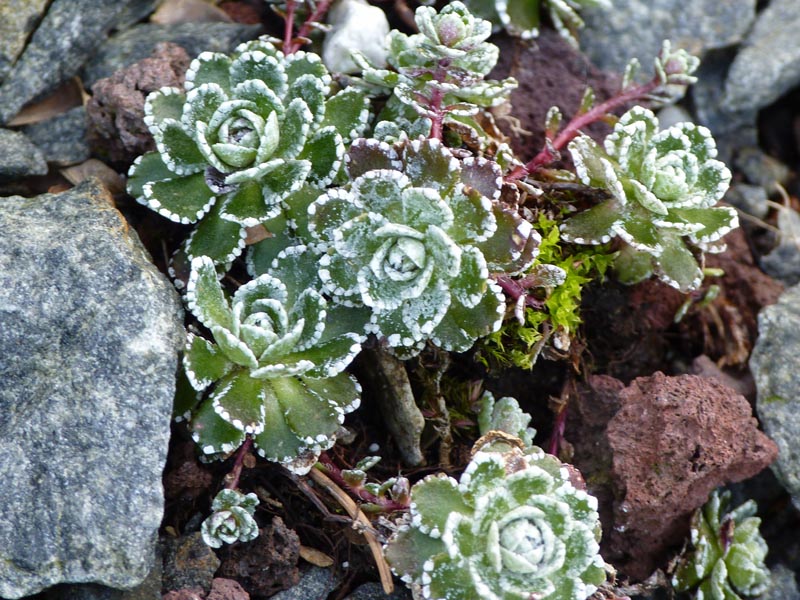
The rosettes are medium-sized, fairly open, composed of obovate to spatulate leaves, broad and fleshy, with a medium green to slightly glaucous gray-green. The white limestone edging that borders the leaves is clear and continuous, forming a well-marked hem all around the blade, particularly visible on the outer leaves of the rosettes. The stolons bearing daughter rosettes are slender and often tinged with wine-red, adding a discreet but constant color contrast between the rosettes.
The plant forms loose to semi-dense tufts, with a low and spreading habit, the rosettes succeeding each other on short stolons without forming a cushion as compact as some other forms of the species. This more airy, almost natural aspect is one of the characteristics that distinguish this cultivar from the very tight cushion forms.
In its natural environment, its flowering extends from June to August. In cultivation, it generally occurs in May-June, with panicles of white flowers borne on reddish stems about ten centimeters tall.
It requires a well-drained substrate, preferably limestone, in full light to slight partial shade, without stagnant moisture in winter. It is suitable for a reconstituted Pyrenean rock garden or any composition with a natural and mountainous character.