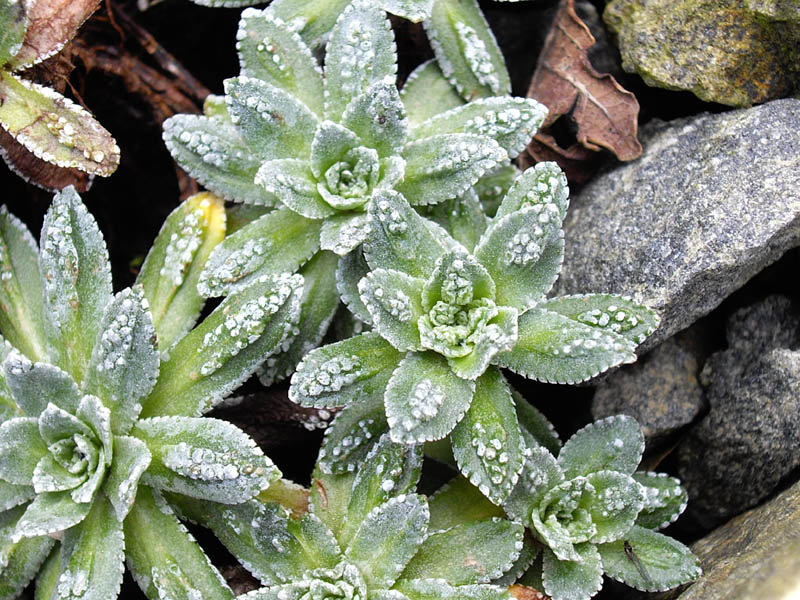
Perennial of the Saxifragaceae family, this cultivar is distinguished by a striking and stable morphological anomaly that earned it its imaginative name, "cockscomb" in English. The center of each rosette presents a partial fasciation or dense proliferation of small, tight, and crisped leaves, forming a central, bushy, and irregular bud that sharply contrasts with the usual arrangement of the species' rosettes.
The leaves are oval to spatulate, medium green to gray-green, and bear on their margins and surface clusters of white calcareous secretion forming irregular and prominent granules, much coarser than the simple continuous border observed in most other forms of S. paniculata. This abundant and lumpy calcareous encrustation, sometimes covering a large part of the blade, is a second immediately observable distinctive trait.
The plant forms low, spreading clumps of medium to large rosettes, with an irregular appearance due to the central fasciation, gradually extending to cover a modest area in rock gardens or troughs.
In its natural habitat, the flowering of S. paniculata extends from June to August. In cultivation, 'Cockscomb' generally blooms in May-June, but it is above all its singular foliage that justifies its place in a collection.
It requires a very well-drained substrate, preferably calcareous, in full light, sheltered from stagnant moisture. Cultivation in a trough is particularly suitable, allowing close observation of the unusual details of its foliage.