A perennial from the Saxifragaceae family, this form is linked to the populations of Carniola, a historical region corresponding to present-day Slovenia and the adjacent territories of the eastern Alps, where S. paniculata colonizes limestone rocks and cliffs between approximately 800 and 2,000 meters.
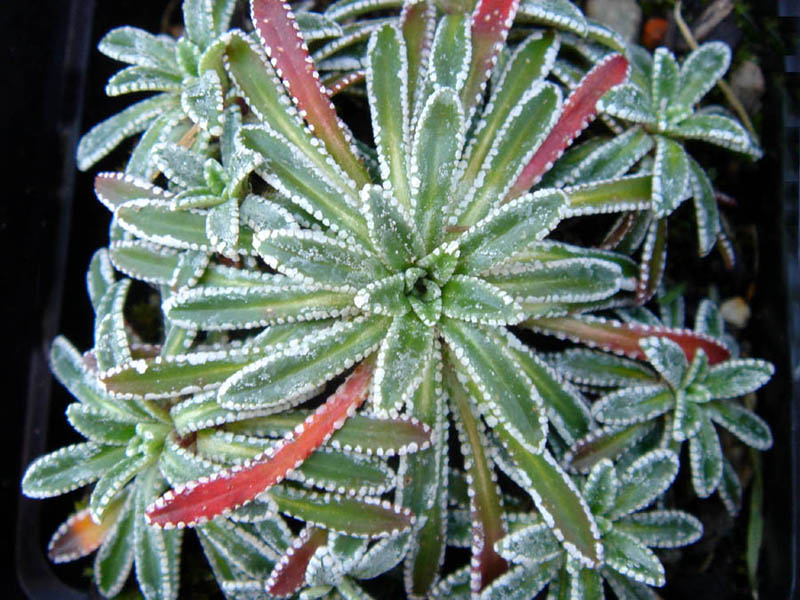
What immediately distinguishes 'Carniolica' within the group is the very particular morphology of its rosettes. The leaves are noticeably longer and narrower than in the usual forms, linear to lanceolate, spread out in a tightly radiating star, dark green to gray-green on top, and bordered with a string of remarkably clear white calcareous beads running along the entire length of the blade. This fine-rayed star arrangement gives the rosettes a completely different appearance from the classic spatulate forms of the species, almost comparable to certain houseleeks or to saxifrages of the Ligularia section with narrow leaves.
The rosettes, individually quite large, multiply to form dense, domed cushions that can reach 20 to 30 cm in diameter on established specimens. In cold weather or at the end of the season, the outer leaves of the rosettes take on intense wine to reddish-brown hues, strongly contrasting with the dark green center and the white calcareous edge.
In its natural habitat, its flowering extends from June to August. In cultivation, it generally occurs in May-June, with flowering stems bearing loose panicles of white flowers.
It requires a well-drained substrate, preferably calcareous, in full light, with protection against stagnant winter moisture. It is particularly suitable for troughs and well-tended rockeries where the uniqueness of its foliage can be appreciated up close.