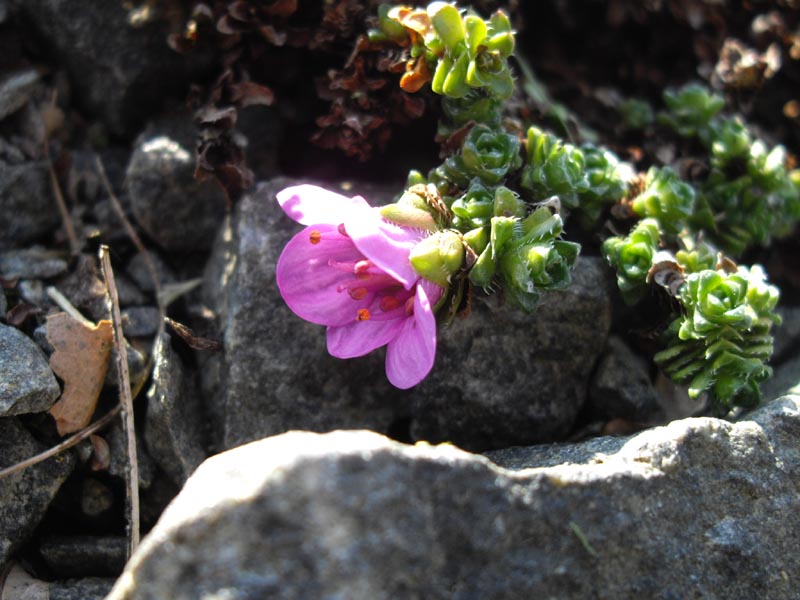
Selected cultivar of the opposite-leaved saxifrage, a perennial from the Saxifragaceae family. Like the type species, it is of arctic-alpine origin, found in the major mountain ranges of Europe and circumpolar regions, where it colonizes rocks, scree, and crevices between 1,500 and 3,500 meters.
It forms a very dense creeping carpet, 3 to 5 cm in height with a width that can reach 20 cm, consisting of thin stems bearing tiny oval, fleshy, dark green leaves arranged in opposite pairs. The flower buds, clearly visible in the photos, are a deep pink-purple and gradually open along the branches.
The flowers are generous, a bright pink-purple with five widely spread petals veined with a deeper pink, with stamens bearing orange-reddish anthers that animate the center of each flower. This cultivar is renowned for its particularly abundant flowering and superior vigor compared to many forms of the species. In its natural habitat, its flowering extends from May to August depending on the altitude. In cultivation, it occurs as early as March-April.
It requires an alkaline, very well-drained soil, cool in depth without being dry, with a shaded or semi-shaded exposure. It suffers from summer heat and a north exposure is essential. It is suitable for rock crevices, alpine troughs, and well-constructed mineral rock gardens.