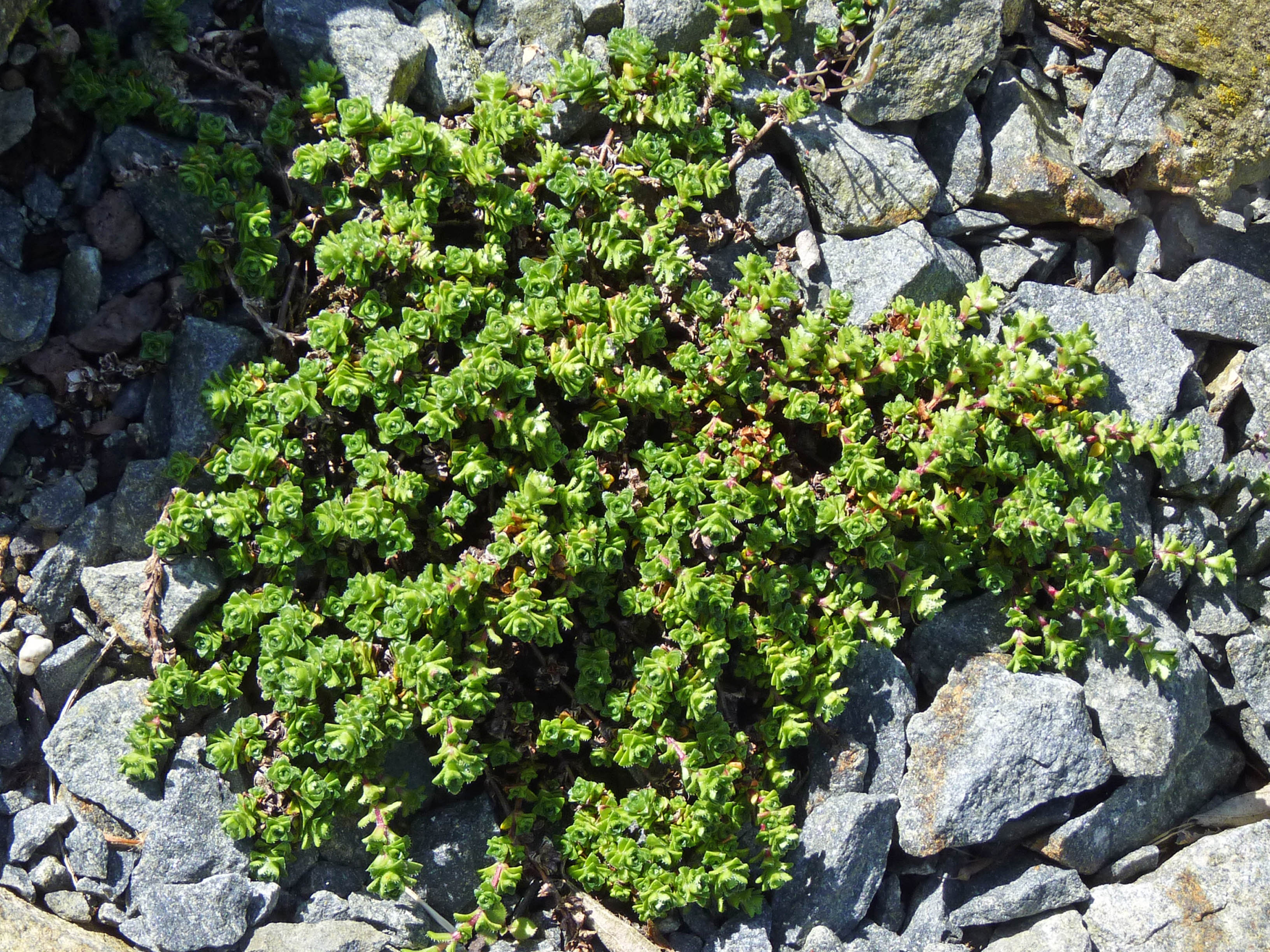
A perennial of the Saxifragaceae family, with an arctic-alpine circumpolar distribution, one of the most widely spread of the genus. It is present in all the major mountain ranges of Europe, in the Arctic, Central Asia, and North America. It colonizes rocks, scree, glacial moraines, and rocky slopes, on various substrates, siliceous or calcareous, generally between 1,500 and 3,500 meters, sometimes beyond.
It forms creeping and dense mats, consisting of thin branched stems bearing small oval, fleshy leaves, opposite in pairs on the stem — a characteristic that inspired its name — from bright green to dark green, often tinged with purple on exposed parts. The ends of the stems are topped with small tight rosettes that give the mat a very recognizable granular appearance.
The flowers, solitary at the top of the branches, are a bright pink-purple to intense magenta, with five widely open petals, covering the cushion to the point of almost entirely masking the foliage at full bloom. In its natural habitat, its flowering extends from May to August depending on the altitude, often as soon as the snow melts. In cultivation, it generally blooms in March-April.
It requires a very well-drained soil, cool in depth, neutral to calcareous, with a shaded or semi-shaded exposure. It dreads summer heat and drought; a northern exposure is essential. Suitable for alpine troughs, mineral rockeries, and rock crevices.