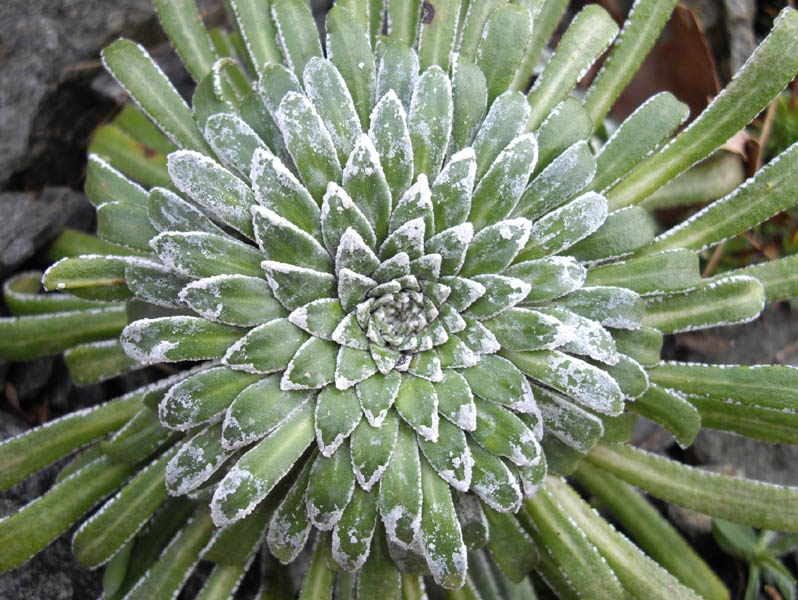
Monocarpic perennial of the Saxifragaceae family, native to the Pyrenees and the mountain ranges of northern Spain and Morocco. It colonizes vertical limestone cliffs and exposed rock crevices, generally between 500 and 2,000 meters in altitude.
It spends several years forming a solitary, perfectly symmetrical rosette, which can reach 15 to 20 cm in diameter. The leaves are long, narrow, spatulate, with a glaucous green color, bordered along their entire length by a white calcareous encrustation produced by the hydathodes, which draws a clear and regular edge. The tightly spiral arrangement of these leaves gives the rosette a remarkable geometry, almost evoking a mathematical construction.
At the end of its growth, the plant produces a floral stalk that can exceed 30 to 50 cm, densely covered with five-petaled white flowers, forming a large pyramidal panicle. After this unique flowering, the mother rosette dies. In its natural habitat, its flowering extends from May to July. In cultivation, it generally occurs between May and June depending on the conditions.
It requires a limestone soil, very well-drained, preferably in a vertical or inclined position to avoid any accumulation of water at the heart of the rosette. A sunny to semi-shaded exposure is suitable. It is ideally cultivated in wall crevices or limestone rock gardens.