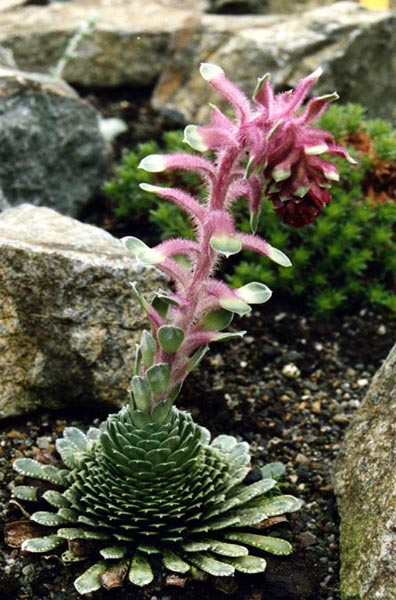
It forms a flattened, symmetrical, and very ornamental rosette, composed of glaucous spatulate leaves, whose margins are dotted with white calcareous deposits produced by hydathodes. The rosette, which can reach 8 to 15 cm in diameter, presents an architecture of remarkable precision.
During flowering, an erect stem of 10 to 25 cm emerges from the center of the rosette. It is densely covered with bracts and sepals of a bright pink to carmine-purple, heavily glandular-hairy, giving it an almost coral-like appearance. The small petals, whitish to pinkish, are largely concealed by these very developed colored sepals — it is the most spectacular element of the plant. The flowering rosette dies after flowering, following the monocarpic behavior characteristic of this section, but the plant perpetuates itself through lateral rosettes.
In its natural habitat, its flowering extends from March to May depending on the altitude. In cultivation, it generally blooms in March-April.
It requires a very well-drained limestone substrate, a sunny exposure, and protection against stagnant winter moisture. It is preferably cultivated in an alpine trough or under cold shelter. Highly sought after by rock garden plant specialists.