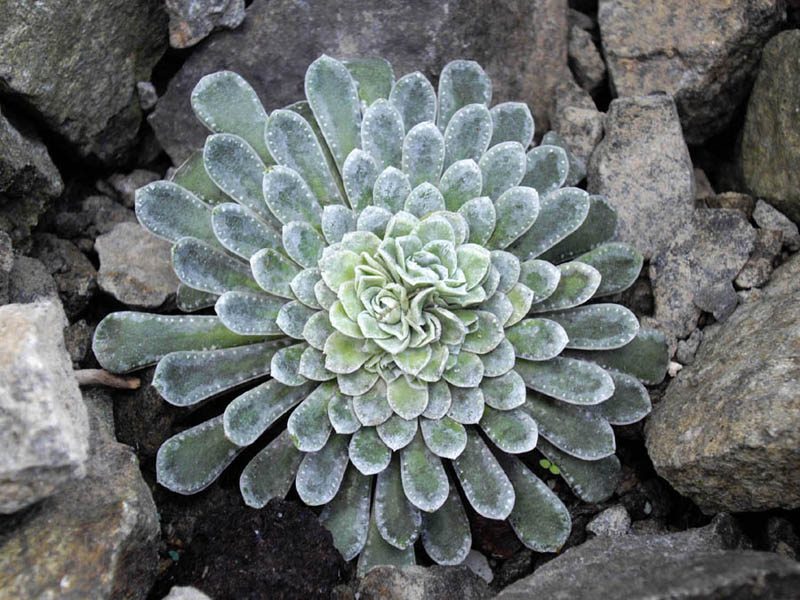
Perennial of the Saxifragaceae family, belonging to the Porphyrion section, endemic to the western Balkans, mainly reported in Albania, Montenegro, and adjacent regions of the former Yugoslavia. It occupies limestone rocks, wall crevices, and high mountain scree, generally between 1,500 and 2,500 meters.
It forms flattened rosettes, remarkably symmetrical, composed of spatulate to obovate leaves, glaucous to gray-green, with margins bearing a fine line of white calcareous deposits from the hydathodes — a typical characteristic of the Ligulatae section to which it was formerly attached. The rosette, which can reach several centimeters in diameter, has a striking geometric architecture, almost evoking a sculpture.
The flowering is one of the most striking spectacles of the genus in this size range. The sepals and floral bracts are bright pink to intense carmine, strongly colored and densely glandular, forming a condensed inflorescence with an almost fleshy appearance before the flowers fully open. The petals are white to pinkish-white, contrasting with the red sepals.
In its natural habitat, its flowering extends from May to July depending on the altitude.
In cultivation, it requires a very well-drained calcareous substrate, sunny exposure, and protection from stagnant winter moisture. It is preferably grown in a pot or alpine trough. Considered delicate but highly sought after by collectors.