Perennial of the Saxifragaceae family, this variety is native to Japan, Korea, and northeastern China, where it grows in moist and shaded undergrowth, on mossy rocks and along streams in forest environments. It belongs to the Irregulares section.
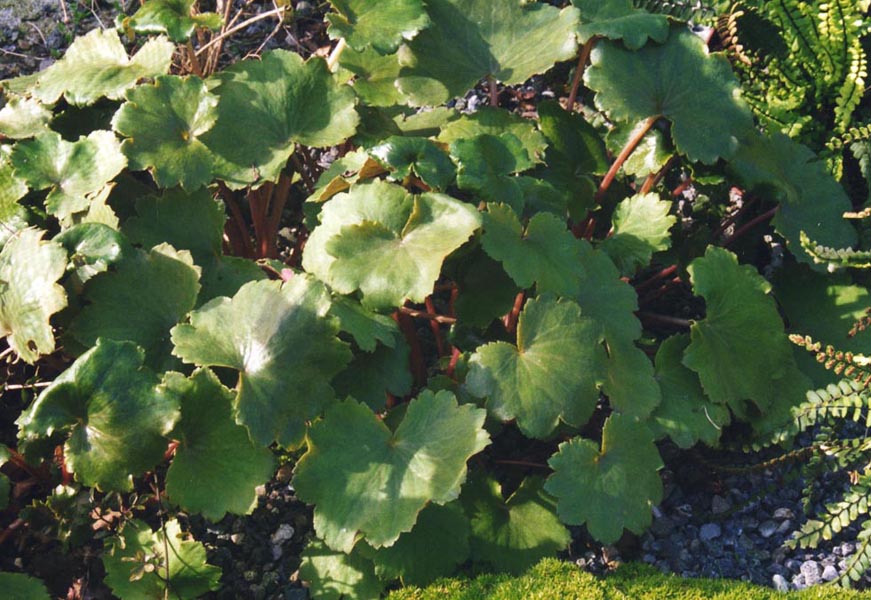
It forms large spreading clumps of round to kidney-shaped leaves, long-petioled, with a shiny green upper surface, often tinged with red-purple underneath and on the petioles. The foliage, persisting late into the season, is one of the most decorative of the genus outside of any flowering.
The flower stems, reddish-brown, rise to 30–40 cm and bear large, very airy panicles of small asymmetrical white flowers, with two lower petals distinctly longer than the other three, a distinctive feature of the section. This irregularity gives the inflorescence an almost dancing lightness.
In its natural habitat, its flowering extends from October to November. In cultivation, it also blooms in autumn, making it one of the few saxifrages to enliven the garden at this season.
It requires cool, humus-rich, well-drained soil, in shade or partial shade, protected from early frosts that can compromise flowering. It is well suited to woodland gardens and compositions with ferns.