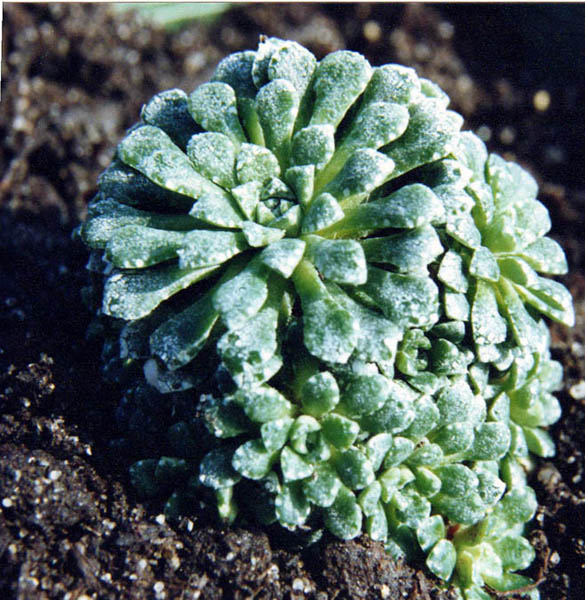
Perennial of the Saxifragaceae family, Saxifraga cochlearis is a saxifrage with leaves encrusted with limestone, belonging to the Ligulatae section. It is endemic to the Franco-Italian Maritime Alps, where it occupies vertical or overhanging limestone cliffs and walls, between approximately 500 and 2,000 meters.
It forms domes of dense rosettes, with spatulate leaves, of medium green, whose edges are highlighted by a white border formed by the limestone deposits of the hydathodes. The type species develops rosettes noticeably wider than those of the 'Minor' cultivar, giving it a more ample and architectural habit. The leaves are slightly curved outward, reminiscent of small spoons, a direct allusion to the epithet cochlearis. The floral stem, thin and dark red, rises to 20–30 cm and bears a loose panicle of pure white flowers, whose contrast with the colored stem is particularly striking.
In its natural habitat, its flowering extends from June to July. In cultivation, it generally occurs in May-June.
It requires a limestone substrate, very well-drained, a sunny to semi-shaded exposure, and protection against stagnant moisture in winter. It is well-suited to cultivation among limestone rocks or in an alpine trough.