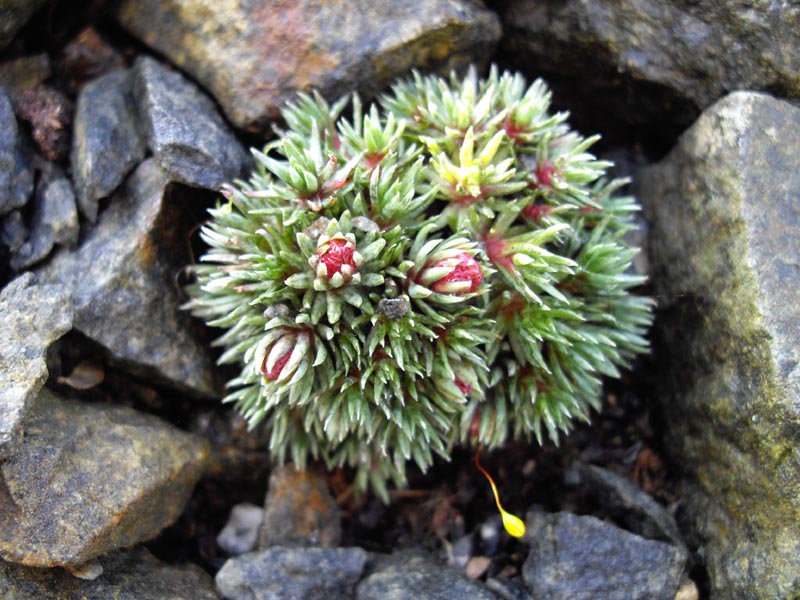
Perennial of the Saxifragaceae family, this cultivar of Saxifraga burseriana shares the origins of the type species, confined to the rocks and calcareous screes of the Eastern Alps and the Dolomites, between 1,500 and 2,800 meters altitude. It is said to have been introduced in 1975 by the German nurseryman Hans Simon, who attributes its origin to the Seissera gorges, on the Montasio massif, in the Julian Alps.
It forms a compact and tight hemispherical cushion, with rosettes of linear, glaucous, rigid, and mucronate leaves. The flower buds with bright red calyxes, which emerge directly from the cushion before opening, are particularly striking. The flowers are pure white, borne on short reddish stems. In its supposed natural habitat, flowering would occur in July. In cultivation, it blooms significantly earlier, from March-April.
Like all members of the group, it requires perfect drainage, a calcareous and lean substrate, a well-sunny exposure, and fears stagnant winter humidity.