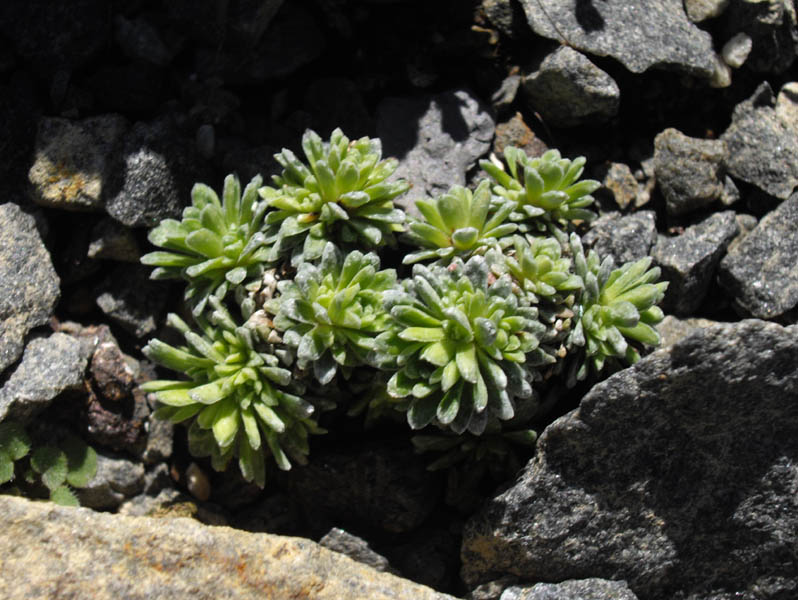
A perennial of the Saxifragaceae family, this saxifrage is endemic to the Pyrenees, where it colonizes limestone cliffs and walls, rocky crevices, and consolidated scree, generally between 1,800 and 3,000 meters altitude. It belongs to the Porophyllum section, which includes the so-called encrusting saxifrages.
It forms dense, very compact hemispherical cushions, made up of small, imbricated rosettes with short, rigid, gray-green leaves, whose edges secrete limestone, revealing characteristic small whitish dots. This tight cushion form allows it to withstand the extreme conditions of exposed walls.
The flowers, sulfur yellow to pale yellow, are borne on short branched stems that emerge above the cushion. In its natural habitat, its flowering extends from June to August depending on altitude and exposure. In cultivation, it generally blooms in May-June.
Its cultivation requires perfect drainage, a sunny exposure, and a lean limestone substrate. It is traditionally grown in pots or troughs, sheltered from excessive winter rains which are more harmful to it than frost. Root competition with other plants is unfavorable; it prefers isolation among the stones of a well-drained rock garden.