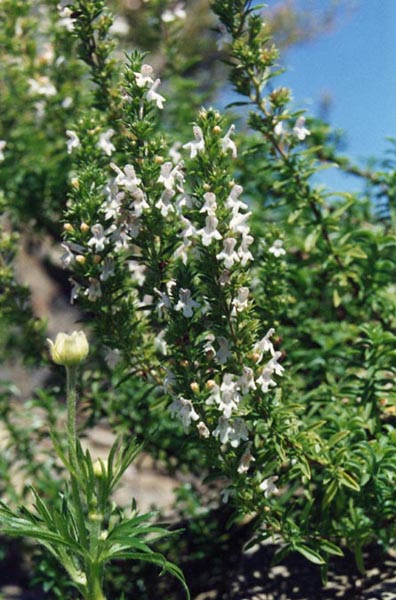
Perennial sub-shrub of the Lamiaceae family, mountain savory is native to the Mediterranean rim, southern Europe and Asia Minor. It naturally grows on sunny limestone rocks, open garrigues, rocky slopes, and low cliffs, from sea level up to about 1,800 meters in the southern massifs.
It forms a dense, upright bush, 15 to 30 cm in height, with woody stems at the base, very branched, giving it a compact and orderly appearance. The foliage, persistent, consists of small linear to lanceolate, dark green, rigid leaves, dotted with aromatic glands; when crushed, they release a powerful and peppery scent, more intense than that of the annual savory.
The bilabiate flowers, white to slightly pink or pale lavender depending on the individual, are arranged in dense and close whorls on upright stems, forming very distinct flowering spikes. In its natural habitat, its flowering extends from July to October. The flowering stems are very visited by bees.
Both a culinary and ornamental plant, it has been used since Antiquity as a condiment and medicinal plant; Virgil already mentioned it among the useful plants to cultivate near beehives. In cultivation, it requires well-drained soil, preferably limestone, in full sun, and easily withstands summer drought once established.