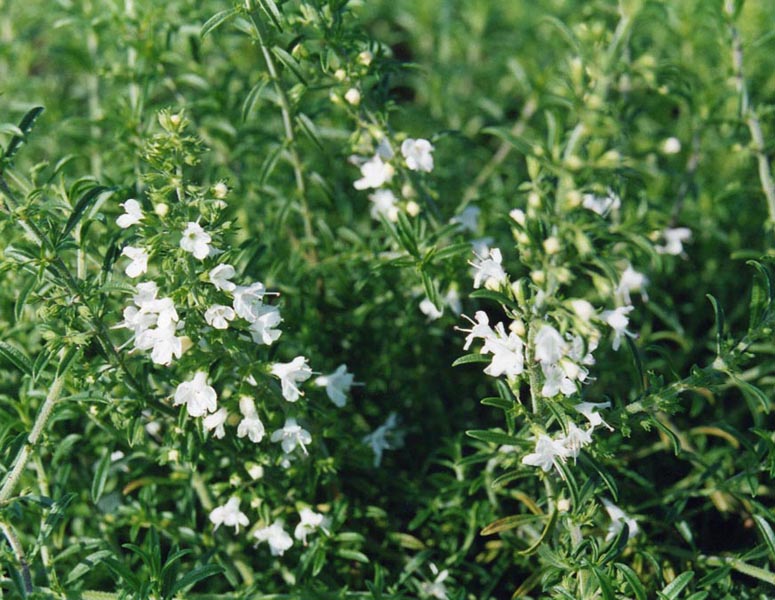
Perennial of the Lamiaceae family, this savory is endemic to the Balkan Peninsula, mainly found in Croatia, Bosnia and Herzegovina, and the adjacent coastal and sub-coastal regions. It grows on limestone screes, open garrigues, and well-exposed rocky slopes, in full sun, in typically Mediterranean to sub-Mediterranean warm and dry conditions.
It forms a dense, bushy sub-shrub, 10 to 20 cm in height, with woody stems at the base and herbaceous at the top. The foliage consists of small linear to narrowly lanceolate leaves, dark green, aromatic when crushed, reminiscent in habit of other perennial savories of the genus.
The flowers are bilabiate, white to very slightly pinkish, arranged in spaced whorls along the upright stems, creating an airy and light effect on the whole plant. In its natural habitat, its flowering extends from July to September. The name alternipilosa refers to the characteristic alternate hairiness of the stems, observable with a magnifying glass.
In cultivation, it requires well-drained, light, preferably calcareous soil, in full exposure. It tolerates summer drought and some winter harshness provided the soil remains dry. It finds its place in rock gardens, elevated borders, or between the slabs of a sunny pavement, where its persistent aromatic foliage constitutes an additional attraction outside the flowering period.