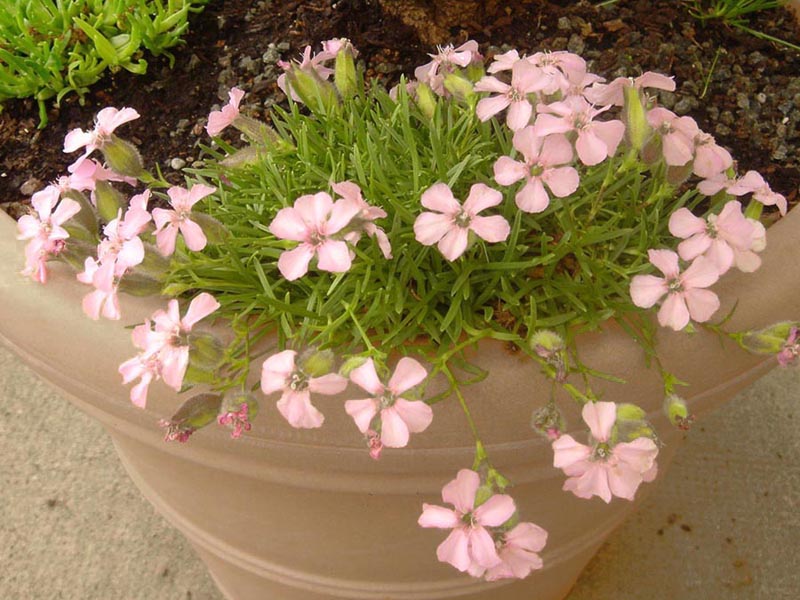
Perennial of the Caryophyllaceae family, this taxon is a natural or semi-natural hybrid between Saponaria pumilio and Saponaria ocymoides, reported in the Alps. In cultivation, it is appreciated for combining the compactness of one of its parent species with the floral generosity of the other.
It forms a dense and spreading cushion, with fine stems slightly drooping at the edges, not exceeding 5 to 8 cm in height at the center, with a natural tendency to overflow the container or spread between the stones of a rock garden. The leaves are narrowly linear, bright green, tightly packed along the stems.
The five-petaled flowers are a very pale pink, almost flesh-colored, noticeably softer than that of Saponaria ocymoides, borne in small numbers at the top of slender stems emerging from the cushion. This delicate, milky hue is one of the characteristics that immediately distinguish this hybrid from its congeners with more intense pinks. In cultivation, flowering generally occurs from May to June.
It requires light, well-drained soil, in full sun exposure, and tolerates drought well once established. Sensitive to excess winter moisture, it is advantageously cultivated in a trough or elevated rock garden. A light pruning after flowering maintains the compactness of the habit.