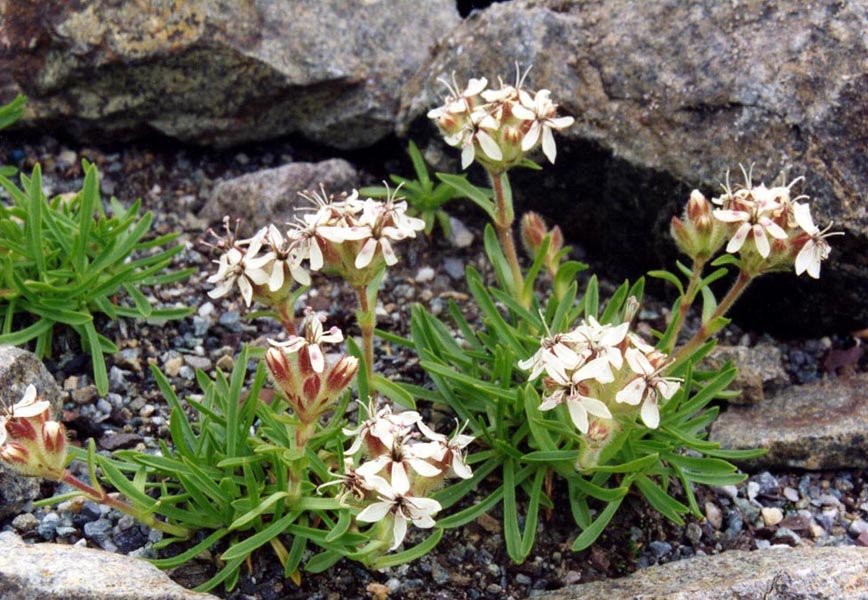
Perennial of the Caryophyllaceae family, this soapwort is a species of the western Alps, mainly present in the massifs of Piedmont, the Aosta Valley, and the southern French Alps. It is strictly confined to siliceous scree, moraines, and high-altitude rocky areas, generally between 2,000 and 3,000 meters, on an acidic, poor, and very well-drained substrate.
It forms small, loose, and low tufts, not exceeding 5 to 10 cm in height when in bloom, with slightly branched thin stems. The leaves are narrowly lanceolate, medium green, grouped in rosettes or bundles along the stems.
The flowers, with five petals, are cream white to pale yellowish white, borne in small loose corymbs at the top of the stems. The calyces are often tinged with reddish-brown, creating a subtle but characteristic contrast with the light petals. In its natural habitat, its flowering extends from July to August.
It is one of the few soapworts with non-pink flowers, which immediately distinguishes it from its alpine congeners. In cultivation, it requires an acidic, very well-drained soil, based on siliceous gravel, in full sun, with moderate humidity in summer. It is preferably grown in a trough or specialized rock garden for high mountain acid-loving plants and remains uncommon outside specialized collections.