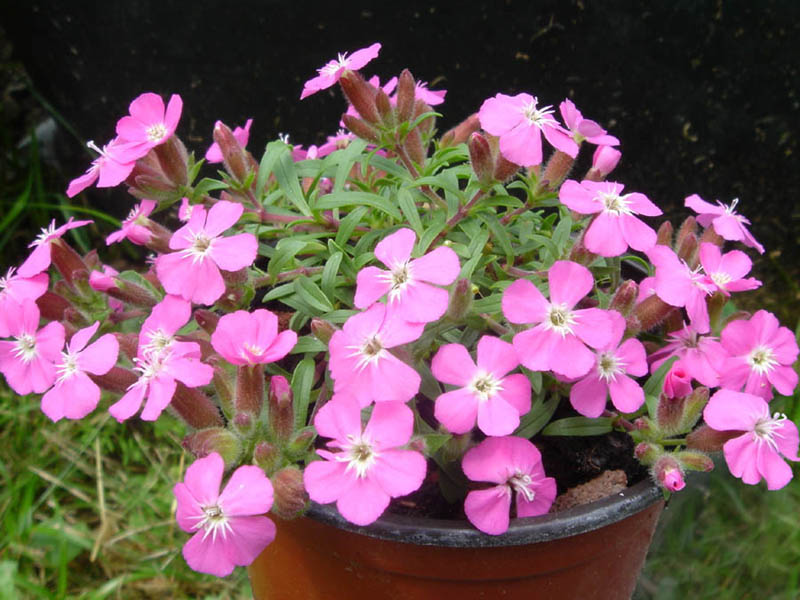
Perennial of the Caryophyllaceae family, this cultivar is a horticultural hybrid resulting from crosses between species of the genus Saponaria, selected by Bressingham Gardens nurseries in England. It does not have its own natural habitat, but its parent species are native to the mountainous regions of southern Europe, where they colonize screes, rock gardens, and rock crevices in well-drained terrain.
It forms a dense and compact cushion, very regular, barely exceeding 8 to 10 cm in height, with thin stems bearing small, lanceolate, narrow, medium green leaves, slightly pubescent. The compactness and neatness of the habit make it a plant particularly suited for cultivation in pots, troughs, or rock gardens.
The flowers have five petals, bright pink to deep magenta pink, with a small well-visible white center, abundantly borne above the foliage. The flowering in cultivation extends from May to July, with sometimes a partial resurgence in autumn if conditions are favorable.
It requires a very well-drained, light soil, in full sun exposure. It does not tolerate heavy soils and excess winter moisture well. A light pruning after the first flowering can encourage a resurgence. It is one of the soapworts most regularly recommended by the Alpine Garden Society for container and carefully tended rock garden cultivation.