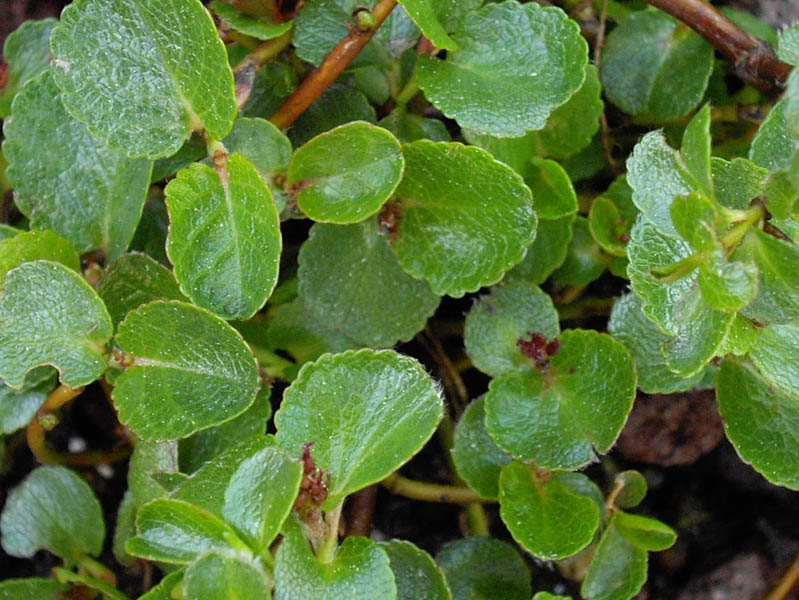
Dwarf shrub of the Salicaceae family, this natural hybrid between Salix serpyllifolia and Salix retusa is reported in the Alps, where the ranges of the two parent species overlap on high-altitude lawns and rocks, generally between 1,800 and 2,800 meters. Like its parents, it occupies rocky substrates, stabilized scree, and stony lawns, on both limestone and silica depending on the locations.
It forms strictly creeping clumps, with woody stems spreading close to the ground, with a height not exceeding 5 to 8 cm. The foliage shows intermediate characteristics between the two parents: the leaves are larger than those of Salix serpyllifolia, oval to obovate, with a crenate or slightly denticulate margin in the upper half, reminiscent of Salix retusa, but with a slightly bullate or finely wrinkled surface, of a medium to dark green and shiny. The stems are reddish to reddish-brown, a characteristic inherited from Salix serpyllifolia.
The catkins are small, short, with reddish bracts, appearing simultaneously or slightly after the leaves. In its natural habitat, flowering extends from July to August depending on the altitude.
In cultivation, as with its parents, it requires a very well-drained mineral substrate, in full light, with moderate humidity. Its hybrid status may make it slightly more vigorous than the parent species, although this observation remains to be confirmed on a horticultural scale. It is suitable for specialized alpine rock gardens and dwarf willow collectors.