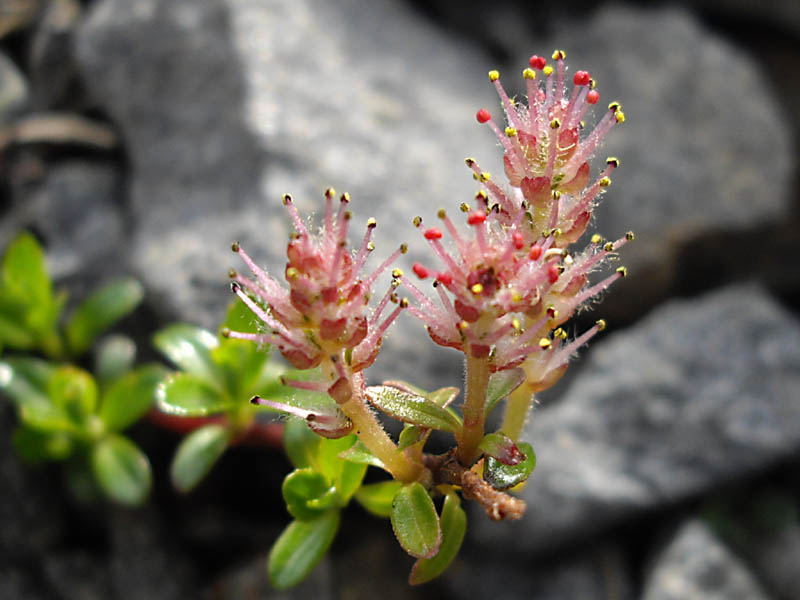
Dwarf shrub of the Salicaceae family, Salix lindleyana is native to the mountains of Central and Southern Asia, mainly the Himalayas, Tibet, and adjacent regions, where it grows on scree, moraines, and rocky slopes at altitude, generally between 3,000 and 5,000 meters. It is part of a group of Himalayan dwarf willows that are of increasing interest to alpine plant collectors.
It forms strictly creeping tufts, with woody stems spreading flat on the ground over stones and gravel, never rising, with a height not exceeding 5 to 8 cm. The stems are thin, reddish to reddish-brown, bearing very small leaves, oval to sub-orbicular, glossy green on the upper side, arranged regularly along the branches.
The catkins are short but remarkably colored for a willow of this size, with stamens and stigmas taking on bright pink to carmine red and golden yellow hues, giving them a distinctly ornamental appearance unusual in the genus. In its natural habitat, its flowering extends from June to August depending on the altitude.
This contrast between the red of the anthers and the pink of the filaments, on a plant almost lying between the stones, constitutes its most immediately striking feature at anthesis.
In cultivation, it requires a very well-drained, mineral substrate, in full exposure, with moderate humidity. It is suitable for alpine or Himalayan-style rock gardens and specialized containers for dwarf willow enthusiasts.