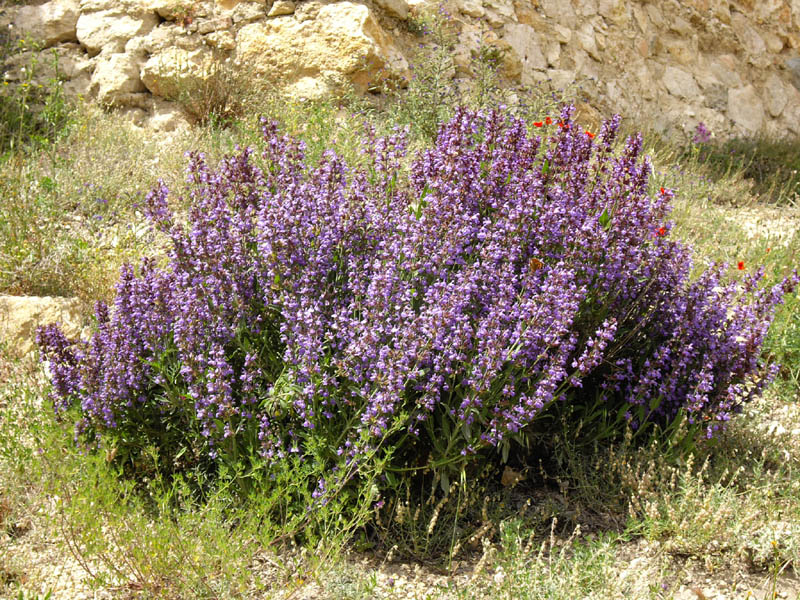
photographed in Spain
photographed in Spain
Subshrubby perennial of the Lamiaceae family, Salvia lavandulifolia is native to the Iberian Peninsula and southern France, where it occupies garrigues, dry grasslands, and rocky limestone slopes, generally between 300 and 1,800 meters in altitude. It is particularly well represented on the plateaus and arid slopes of central and eastern Spain.
It forms rounded and dense bushes, reaching 30 to 60 cm in height, with woody stems at the base. The leaves are narrow, lanceolate, with a silvery-gray and finely tomentose surface, reminiscent in shape and color of lavender, which is directly reflected in the Latin epithet. They emit a powerful camphoraceous aroma at the slightest touch, more intense than that of Salvia officinalis.
The flowers are bilabiate, a true violet-blue to lilac, grouped in upright and numerous spikes that generously cover the clump at the time of flowering. In its natural habitat, its flowering extends from April to June depending on altitude and exposure. In cultivation, it generally occurs in May-June.
It requires a perfectly drained soil, poor to moderately fertile, preferably calcareous, in full sun exposure. It tolerates summer drought well and withstands cold down to about -15 °C in dry soil. It is perfectly suited to sunny rockeries, dry gardens, and calcareous slopes.