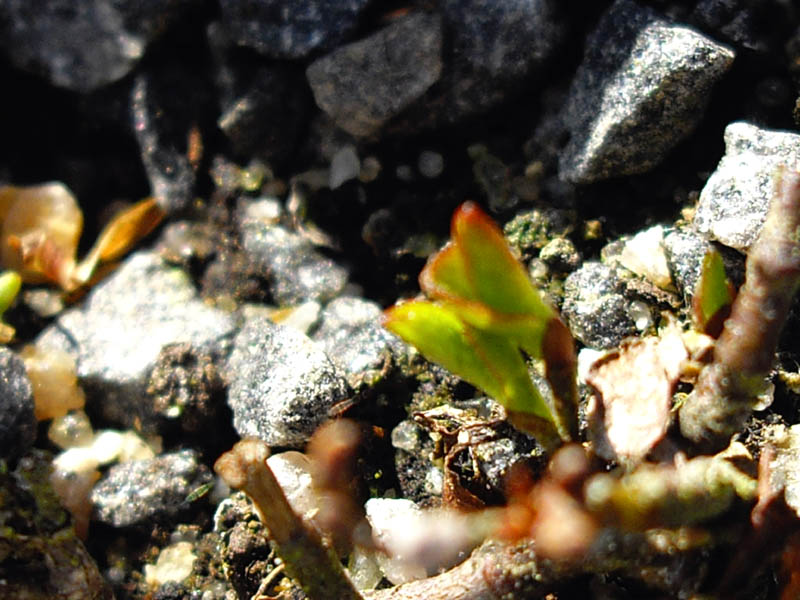
Dwarf shrub of the Salicaceae family, Salix herbacea is one of the smallest woody plants in the world. It is found in the arctic and subarctic zones of Europe, Iceland, Greenland, and North America, as well as in the high European mountains, from the Pyrenees to the Carpathians, including the Alps and the British Isles. It colonizes late snow beds, humid acidophilic lawns, and fine screes, generally between 1,800 and 3,000 meters in the Alps.
Its most striking feature is its entirely underground or surface-level habit, with woody stems creeping beneath the soil surface and only tiny leafy shoots emerging, 1 to 3 cm in height. The plant thus forms discreet and dense mats, almost invisible among the gravel and mosses. The leaves are small, orbicular to oval, bright and shiny green, with well-marked reticulate venation and finely toothed margins.
The catkins are tiny, bearing only two to six flowers, and are easily overlooked. In its natural habitat, its flowering extends from July to August depending on altitude and snow cover.
Salix herbacea plays a notable ecological role in snowy environments, contributing to soil stabilization and feeding certain specialized insects. It is a faithful indicator of microclimatic conditions related to prolonged snow cover.
In cultivation, it requires an acidic, fresh to moist, mineral, and well-drained substrate, in full light. It remains delicate to maintain outside its original habitat and is suitable for knowledgeable collectors with reconstituted alpine or subarctic conditions.