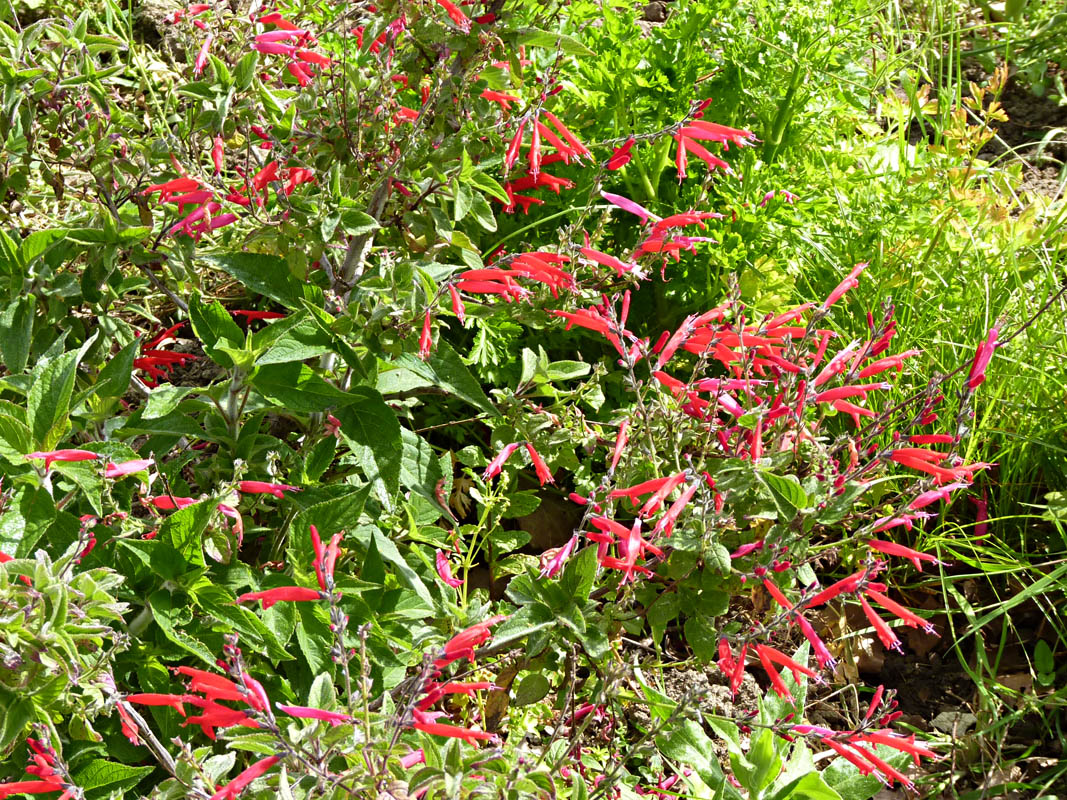
Shrubby perennial of the Lamiaceae family, Salvia elegans is native to the open forests and mountain edges of Mexico and Guatemala, where it grows between 1,800 and 2,700 meters altitude in areas with contrasting seasons, with wet summers and dry, mild winters. It is cultivated in gardens worldwide under warm temperate climates, often treated as a semi-hardy perennial or as a seasonal plant.
It forms bushy and loose clumps, reaching 80 to 120 cm in height under favorable conditions. The leaves are oval to triangular, with a toothed margin, medium green, pubescent, and release a characteristic fruity scent reminiscent of pineapple when crushed, hence its common English name of pineapple sage. This unique fragrance is one of the most immediately recognizable traits of the species.
The flowers are tubular, bright scarlet red, grouped in slender terminal spikes that abundantly succeed one another on the stems. In its natural environment, flowering occurs at the end of the rainy season. In cultivation under our latitudes, it mainly extends from summer to autumn, often until the first frosts.
It requires well-drained, rich soil, in full light or light partial shade, with regular watering during the growing period. It tolerates moderate frosts down to about -5 °C without irreversible damage, vigorously regrowing from its base the following spring. In colder climates, winter mulching at the base is generally sufficient to protect it. Its flowers attract bees and butterflies in cultivation, and hummingbirds in its native range.