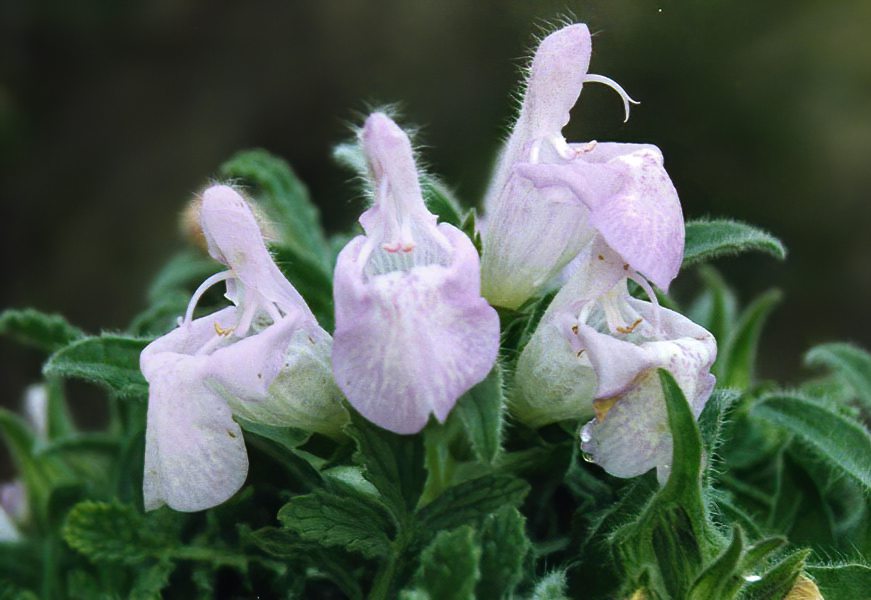
Perennial of the Lamiaceae family, Salvia caespitosa is native to Turkey, where it grows on the rocky slopes and screes of the Anatolian mountains, on well-drained calcareous substrates, at altitudes generally between 1,500 and 2,500 meters. It belongs to a group of dwarf mountain sages little known outside specialized collections.
It forms dense and compact clumps, slightly domed, reaching 15 to 25 cm in height when in bloom. The leaves are small, oval to oblong, with a crenate margin, medium to dark green, with a wrinkled and distinctly pubescent surface, releasing a slight aromatic scent when crushed. The general appearance of the clump, very full and well-defined, resembles more an aromatic cushion than the usual habit of large sages.
The flowers are remarkably large relative to the size of the plant, bilabiate, of a pale lilac pink to delicate lavender, with a distinctly arched and hairy upper lip, characteristic of the genus. They are grouped in sparse whorls, barely emerging above the foliage and generously covering the clump at the time of flowering. In its natural habitat, its flowering extends from May to July. In cultivation, it generally occurs in May-June.
It requires perfect drainage, a substrate poor to moderately rich, preferably calcareous, in full sun exposure. It poorly tolerates prolonged winter humidity, which constitutes the main risk in cultivation under an Atlantic climate. Light protection or an overhanging location can be useful. It is suitable for sunny rock gardens and dry gardens with a Mediterranean or Anatolian inspiration.