Dwarf shrub of the Salicaceae family, Salix breviserrata is an orophyte species of the mountains of Central and Southern Europe, present in the Alps, Carpathians, and Northern Apennines. It occupies moist grasslands and scree, the banks of torrents, and late snow hollows, generally between 1,600 and 2,800 meters in altitude, on varied but often siliceous substrates.
It forms dense, bushy, and branched tufts, upright to slightly spreading, reaching 20 to 50 cm in height. The leaves are oval to elliptical, bright and shiny green on the upper side, paler underneath, with a distinctly toothed margin with small fine and close teeth, a characteristic that gives the species its epithet. The venation is well visible and slightly raised.
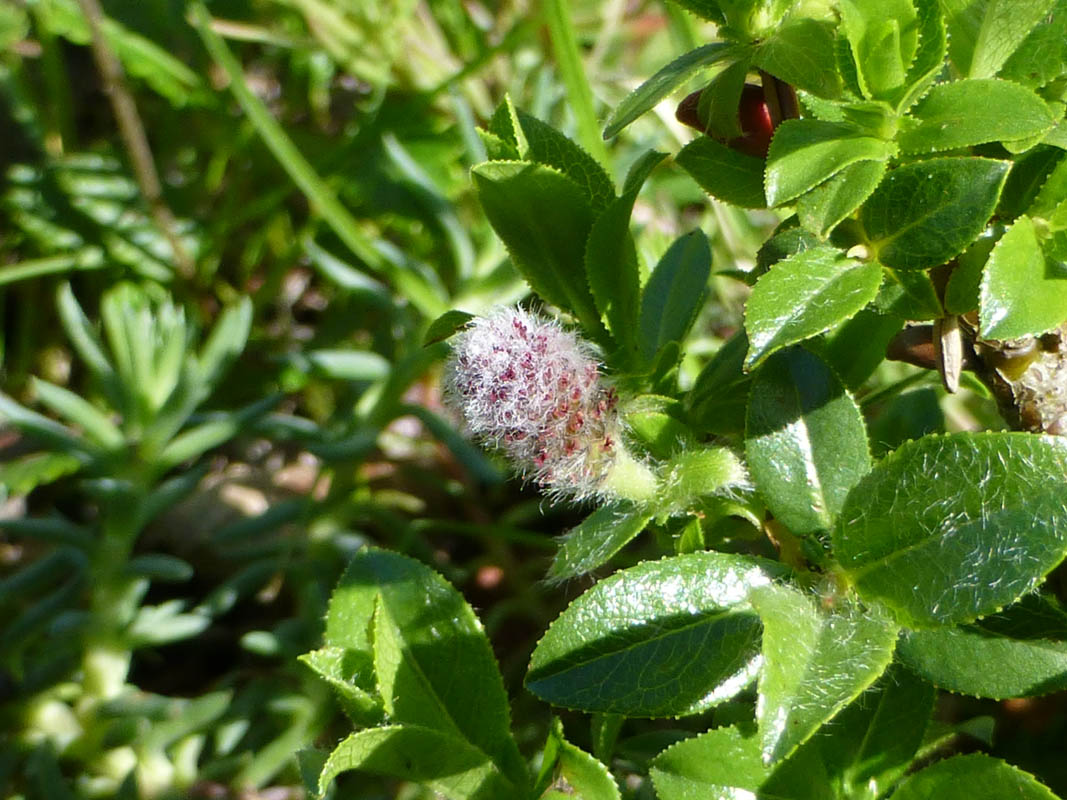
The catkins appear simultaneously with the leaves in spring. They are short, globular to ovoid, densely hairy, with a silky white mixed with red-purple to carmine on the scales and stigmas, giving them a very remarkable bicolored appearance, clearly visible in the photographs. In its natural habitat, its flowering extends from June to July depending on the altitude.
These small bicolored catkins, perched in the bright and shiny green foliage, constitute the main ornament of the species at the time of flowering, with a chromatic contrast that few dwarf willows match.
In cultivation, it is suitable for fresh to moist rock gardens, in full light or very light partial shade, on well-drained but never drying soil. It appreciates situations where soil moisture is maintained in summer, similar to its natural habitat of torrent banks or snow hollows.