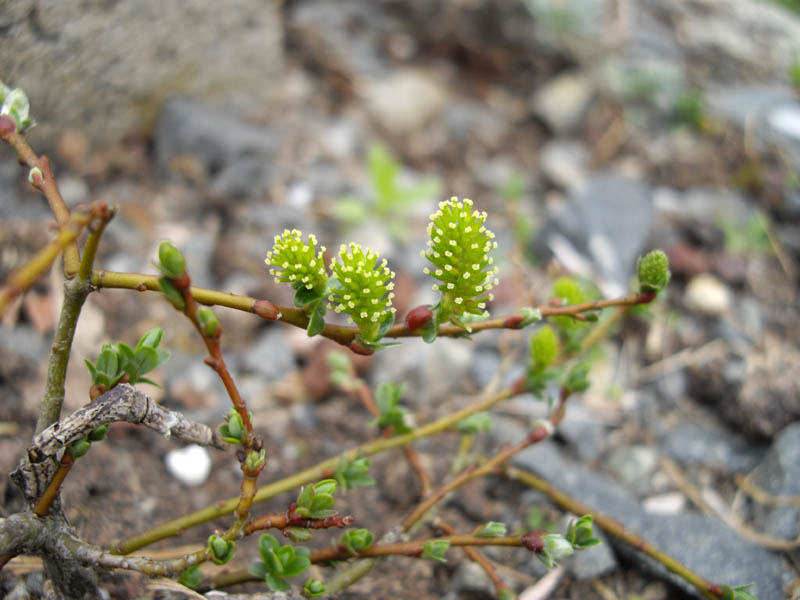
Dwarf shrub of the Salicaceae family, this natural hybrid between Salix arctica and Salix reticulata is found in arctic and subarctic regions, notably in Iceland, Greenland, and in contact zones between the two parent species. It inhabits scree, moraines, rocky slopes, and rocky tundras, often between 500 and 1,500 meters depending on latitude.
It forms creeping and spreading, woody tufts with very characteristic reddish to orange-brown stems, extending flat on stones and gravel without ever rising. The height does not exceed 10 to 15 cm. The leaves are small, oval to sub-orbicular, with a glossy green upper surface and visible venation, reminiscent of those of Salix reticulata while being less leathery and less distinctly reticulated.
The catkins appear in spring simultaneously with the first leaves, erect, short, initially bright green then quickly yellow-green at anthesis, with very visible stamens. In its natural habitat, its flowering extends from May to July depending on altitude and latitude.
In cultivation, it requires a well-drained, mineral substrate, in full light, with regular moisture without waterlogging. It is suitable for large rock gardens and arctic or alpine-style gardens, where its reddish creeping stems remain decorative well beyond flowering. Its exact hybrid status deserves confirmation by a specialist in the genus Salix.