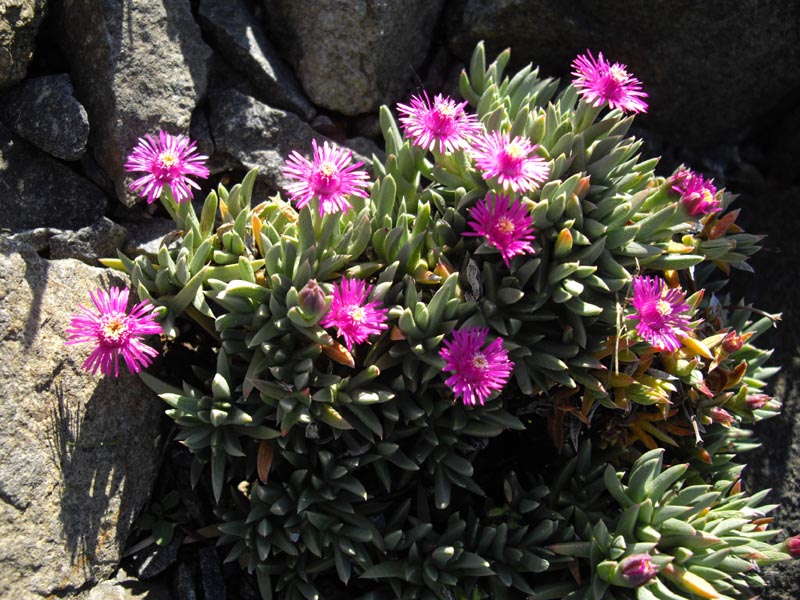
Succulent perennial of the Aizoaceae family, native to the arid and semi-arid regions of the Karoo and the mountainous areas of the Cape, in South Africa. In its natural habitat, it colonizes rocky slopes, rock crevices, and dry screes with poor substrate, under intense sunlight.
It forms a dense and compact cushion, remarkably regular, hardly exceeding 10 to 15 cm in height. The leaves are small, fleshy, trigonal, with a slightly bluish glaucous green, closely imbricated and arranged in short tight shoots that give the plant its characteristic ball-shaped habit. It is precisely this rigid cushion architecture, evoking a miniature architectural form, that immediately distinguishes this species among the Ruschia cultivated in rock gardens.
The flowers, of an intense magenta to bright pink, open in full sun and close in overcast weather; their creamy white center with yellow stamens contrasts sharply with the tight ligules. In its natural habitat, its flowering extends from spring to the southern summer. In cultivation under our latitudes, it generally blooms from May to July.
It requires perfect drainage, full sunlight, and very poor soil. Resistant down to about -7°C provided it is perfectly sheltered from winter moisture, it can be attempted in open rock gardens in climates with dry winters, but is more reliably cultivated in pots or cold greenhouses where winters are wet.