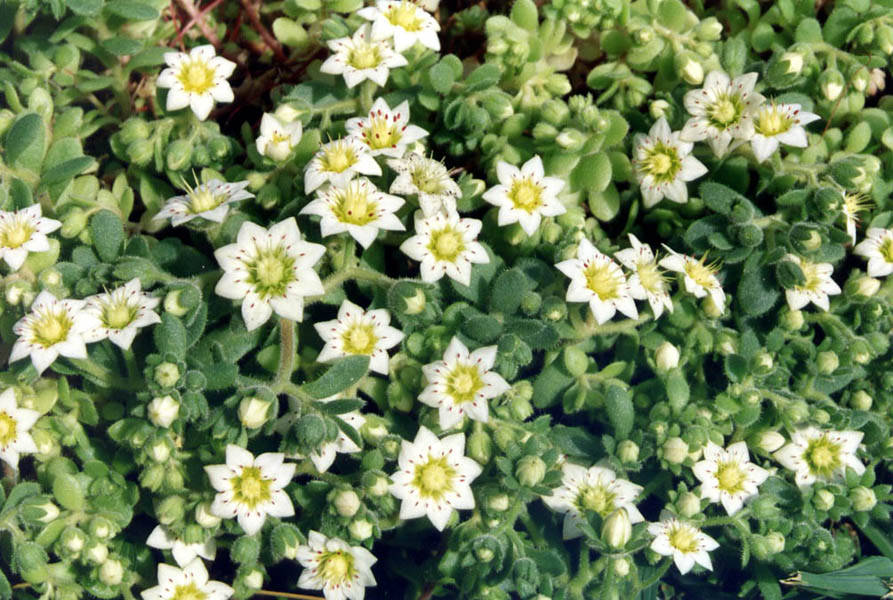
Perennial succulent of the Crassulaceae family, native to the Middle East and Central Asia, notably reported in Afghanistan, Pakistan, and the mountainous regions of the Hindu Kush and western Himalayas. It colonizes rock gardens and rocky walls at high altitudes, on well-drained mineral substrates.
It forms dense mats of small, fleshy rosettes, with oval-spatulate, medium green leaves, slightly hairy, tight and interlocking, which slowly spread to cover the substrate with a compact cushion not exceeding 5 cm in height outside of flowering. The general habit resembles that of a miniature sedum, as recalled by the epithet sedoides.
The flowering is particularly remarkable for the genus. The flowers, borne in dense corymbs flush with the foliage, are star-shaped, pure white to slightly creamy white, with a yellow-green center and very visible dark red anthers that punctuate each flower with a precise and elegant detail. In its natural habitat, its flowering probably extends from June to July depending on the altitude. In cultivation, it generally occurs in June.
It requires perfect drainage, a poor mineral substrate, and full sun exposure. Protection against stagnant moisture in winter is essential.