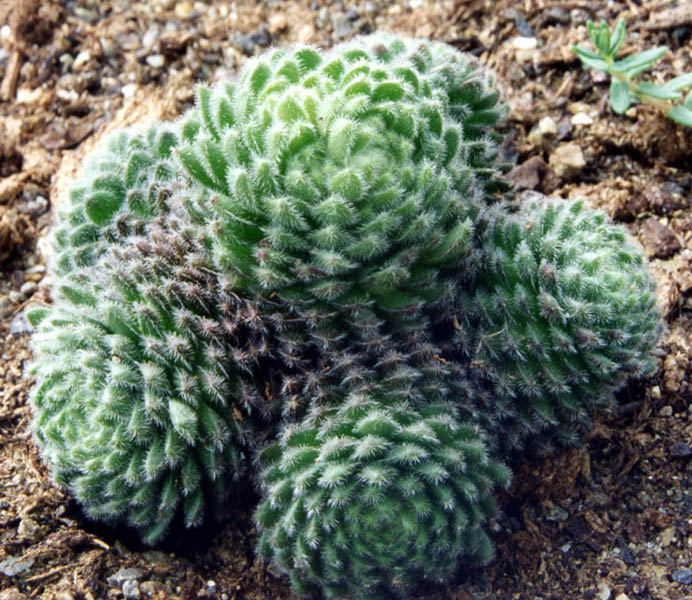
Succulent perennial of the Crassulaceae family, native to Asia Minor, mainly known from Turkey and adjacent regions. It grows in rocky areas and mountain screes, on well-drained mineral substrates, at altitudes generally between 1,500 and 3,000 meters.
It forms small, dense, and tightly packed rosettes, remarkably hairy, which multiply by short stolons to form compact cushion-like clumps, rarely exceeding 5 to 8 cm in height outside of flowering. The leaves are fleshy, oval-spatulate, medium green, entirely covered with conspicuous white hairs that give them a frosted appearance and a soft texture to the touch — this is the most immediately distinctive feature of the species among the rosularias.
The flowering stems, erect and also hairy, bear corymbs of small bright pink to salmon-pink star-shaped flowers, with well-visible stamens. In its natural habitat, its flowering extends from June to July. In cultivation under temperate climates, it generally occurs in June.
Like most rosularias, the flowering rosettes die after fruiting, but the clump is renewed by the lateral rosettes. It requires very well-drained, mineral soil, in full sun, and protection against excessive winter moisture; it is ideally cultivated in alpine rock gardens, in containers, or under cold shelter.