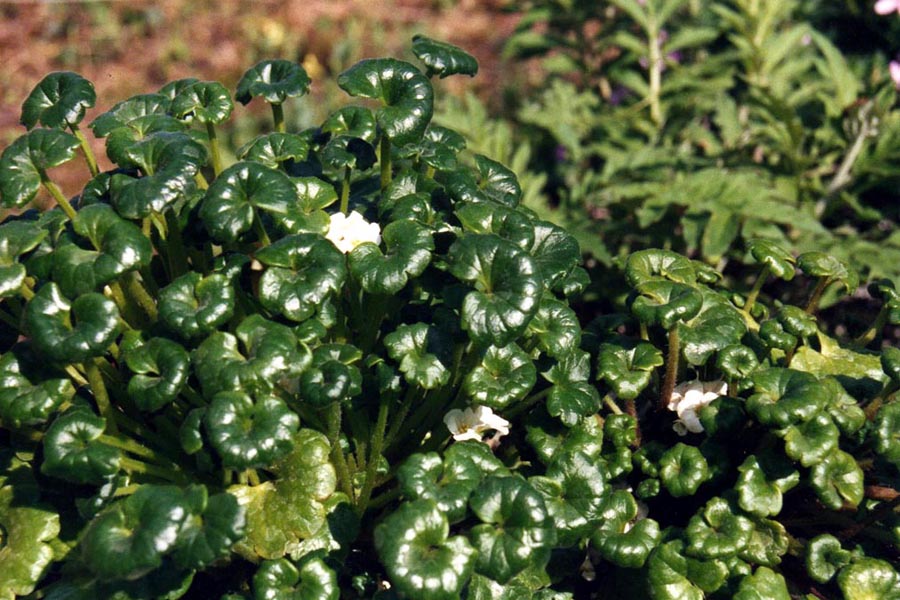
Perennial of the Hydrophyllaceae family, native to the northwest of North America, the Aleutian Islands and Alaska to British Columbia, with locations in Japan according to some sources. The epithet recalls the island of Unalaska, in the Aleutians, where the plant was collected during the Russian expeditions of the early 19th century. It grows in damp rocks, seeping cliffs, rocky banks, and cool slopes, often in coastal or subalpine conditions.
It forms low, dense, mat-forming clumps, 8 to 12 cm in height. The foliage is very characteristic: the leaves are kidney-shaped, deeply lobed and crinkled at the edges, a very dark and shiny green, with a strongly blistered and wrinkled surface, giving it an almost crumpled texture, even more pronounced than in R. californica.
The flowers are white, cup-shaped, with a slightly yellowish throat, borne in small erect scorpioid clusters. In its natural habitat, flowering extends from June to August depending on latitude and altitude.
In cultivation, it requires a cool to shaded location, a humus-rich well-drained soil without summer drying. It is well-suited to cultivation in containers under cold shelter or in crevices of shaded and moist walls.