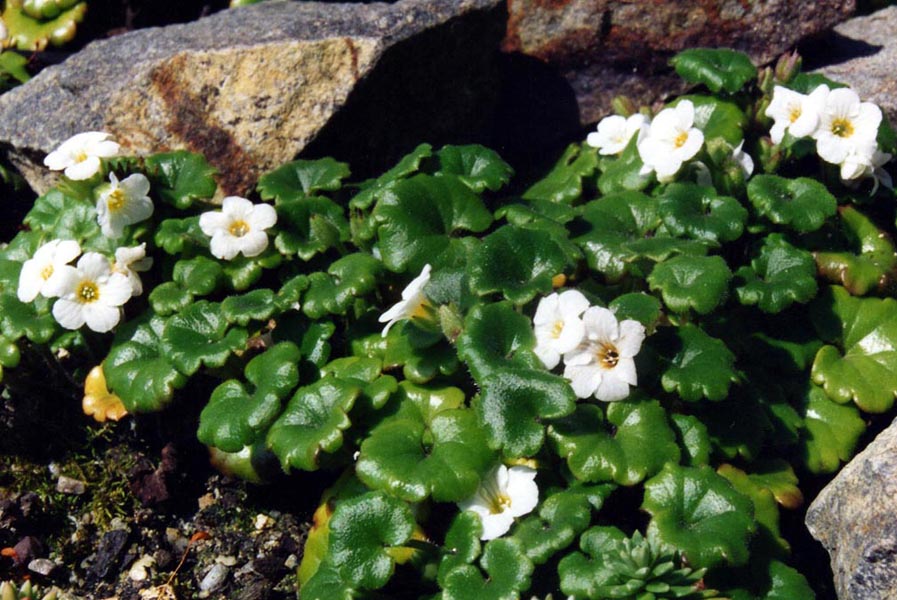
Perennial from the family Hydrophyllaceae (sometimes classified under Boraginaceae according to recent classifications), native to the west coast of North America, from California to British Columbia. It naturally grows in the crevices of moist rocks, dripping cliffs, and cool rocky slopes, often in shade or partial shade, from sea level to mid-altitudes.
It forms low spreading tufts, rarely beyond 10 to 15 cm in height, with a dense and mat-forming habit. The foliage is one of its most remarkable features: the leaves are kidney-shaped to orbicular, slightly lobed, dark glossy green, with a slightly blistered surface and shiny texture that gives them an almost varnished appearance.
The flowers are open cup-shaped, pure white with a cream or slightly yellowish throat, gathered in small scorpioid clusters standing above the foliage. In its natural habitat, flowering extends from March to June. In cultivation, it blooms in spring, often from April.
It requires a cool to shaded location, well-drained soil that does not dry out in summer, rich in humus. It is perfectly suited to crevices in shaded walls, moist rock gardens, or container cultivation under cold shelter.