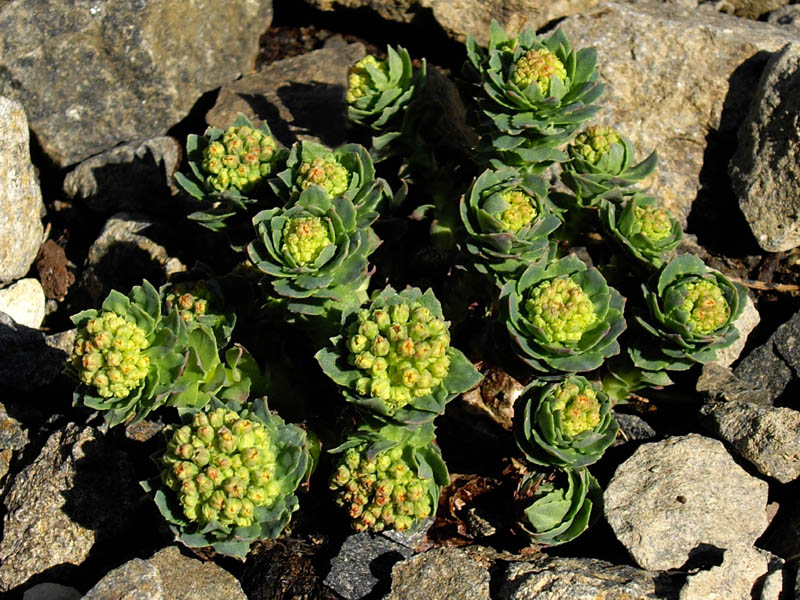
Perennial of the Crassulaceae family, with a wide circumpolar distribution, present in the mountains of Europe (Alps, Scandinavia, British Isles), Central Asia, and North America. In the Alpine region of Europe, it occupies rocks, screes, and rocky ledges between approximately 1,500 and 2,800 meters, on well-drained substrates, often siliceous.
It forms upright clumps of 15 to 35 cm, originating from a thick, fleshy, and branched rhizome with a characteristic fresh rose scent when broken — an immediate distinctive feature. The stems are fleshy, densely leafed with sessile, oval to slightly toothed leaves, glaucous to bluish-green, fleshy, arranged in a tight spiral giving the shoots a very particular architectural appearance.
The species is dioecious. The tiny flowers are grouped in dense, rounded terminal corymbs, bright yellow-green on male plants, slightly duller on female plants. In its natural habitat, its flowering extends from June to August depending on the altitude. In cultivation at low altitude, it generally blooms in May-June.
Rhodiola rosea has been known since antiquity for its adaptogenic properties; its rhizomes have been used in traditional Scandinavian and Siberian medicine, and are the subject of numerous contemporary pharmacological studies. It is cultivated in full sun, in well-drained soil, poor to moderately fertile, with good spring moisture. It withstands intense cold but dreads excessive winter moisture in cultivation.