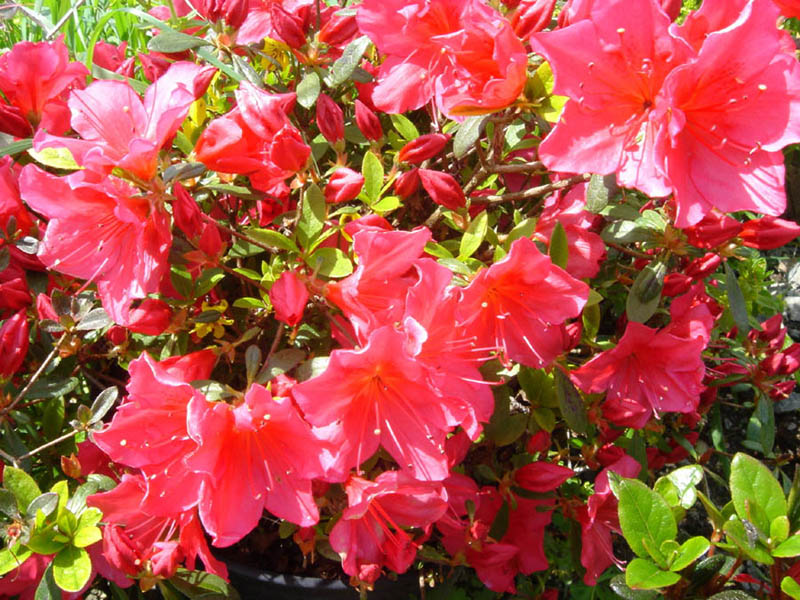
Shrub of the Ericaceae family, this cultivar belongs to the group of Japanese azaleas (section Tsutsusi), whose parent species originate from Japan. Like most azaleas of this group, it is a semi-evergreen to evergreen shrub depending on the climate, with moderate growth and a low, spreading habit, generally reaching 40 to 60 cm in height with often greater spread.
The foliage consists of small, oval, leathery, dark green glossy leaves, which frequently take on purple-bronze hues in autumn and winter, particularly visible on branches exposed to the cold. This contrast between the dark leaves and the very bright flowers is one of the most immediately striking features of the cultivar.
The flowers are large, widely open, of a vivid and sustained pink-red to carmine red, slightly speckled with darker spots at the throat. They are produced in very great abundance and almost completely cover the foliage at the time of flowering, which occurs in April-May in cultivation.
Note: precise information on the origin and breeder of this cultivar cannot be verified with certainty in the available sources.
It requires acidic, humus-rich, fresh, and well-drained soil, without limestone. A sunny to semi-shaded exposure suits it. Its hardiness is satisfactory in regions with moderate winters, but the flower buds may be damaged by severe late frosts.