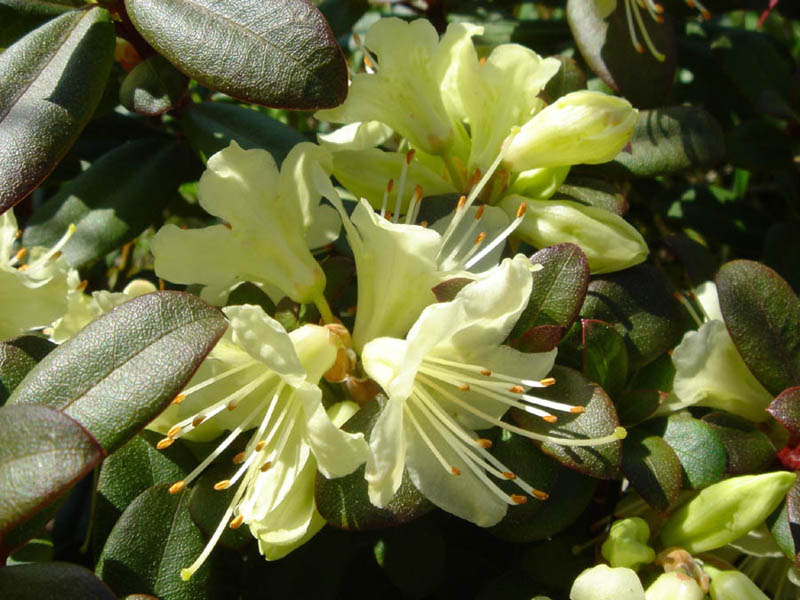
Dwarf shrub of the Ericaceae family, this cultivar is a hybrid obtained from two species native to East Asia, Rhododendron hanceanum from central China and Rhododendron keiskei from Japan. It was selected and registered by the RHS in 1977 and received the Award of Garden Merit.
It forms a dense, compact, and spreading bush, with slow growth, generally reaching 60 to 80 cm in height with a spread often greater. The foliage is one of its most remarkable features throughout the year: the leaves are oval, leathery, dark green slightly blistered in summer, but take on red-bronze to deep purple hues in winter and early spring, a characteristic clearly visible in late-season photos. The young spring shoots are also colored red.
The flowers, gathered in fairly dense terminal corymbs, are widely open, with spreading lobes and prominent stamens with orange anthers, of a delicate pale yellow, almost cream, slightly greenish at opening. This light sulfur yellow shade, uncommon in the genus, combined with the dark foliage, creates a particularly striking contrast. Flowering occurs in April-May in cultivation.
It requires acidic, humus-rich, fresh, and well-drained soil, without limestone. It tolerates a sunny to semi-shaded exposure, but the winter coloration of the foliage is generally more intense in full light. Its hardiness is satisfactory in most temperate regions of Western Europe.