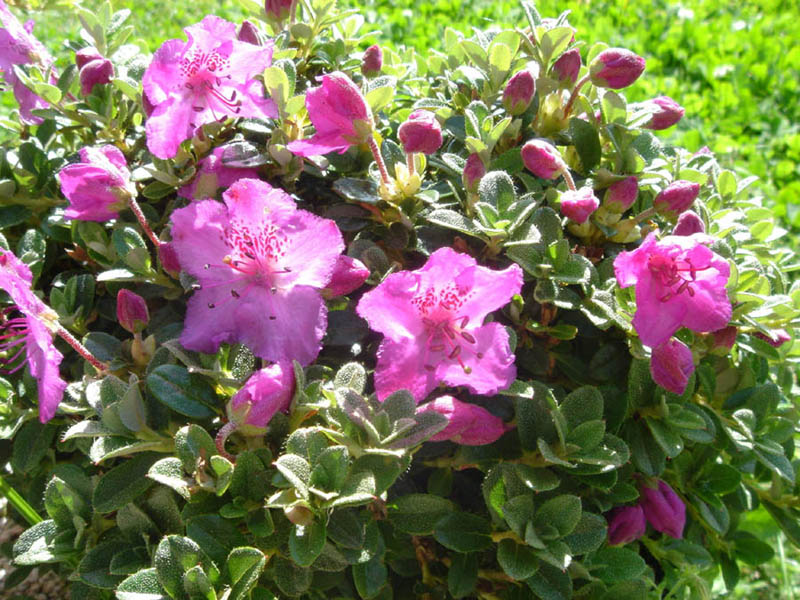
Rhododendron calostrotum subsp. keleticum (Balf.f. & Forrest) Cullen — Dwarf shrub of the Ericaceae family, native to southeastern Tibet, Yunnan, and northern Burma, where it colonizes open alpine meadows, rocks, and rocky slopes at altitudes between approximately 3,500 and 5,000 meters.
It forms a dense and compact cushion, with very slow growth, rarely reaching more than 20 to 30 cm in height with a progressive spread that can exceed 50 cm on an older specimen. The small oval leaves, dark green on the upper side and densely scaly on the underside, give it a fine and tight texture very characteristic of the genus at altitude.
The flowers, large relative to the size of the plant, are a bright pink-purple to magenta, widely open in a flared cup shape, with dark purple speckles clearly visible in the throat. They appear in remarkable numbers, literally covering the foliage at the time of full bloom. In its natural habitat, its flowering extends from June to July. In cultivation in the northern hemisphere, it generally occurs in May.
It requires acidic, humus-rich, cool, and perfectly drained soil, in a semi-shaded or sunny exposure with sufficient atmospheric humidity. It does not tolerate limestone or prolonged summer drought. Its hardiness is good. It is one of the best-suited dwarf rhododendrons for acidic rock gardens.