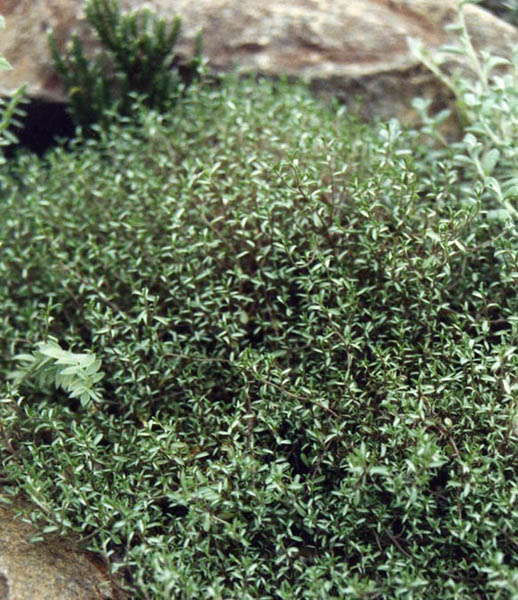
Carpeting perennial of the Asteraceae family, native to New Zealand, where it is widely spread across both main islands. It colonizes alluvial gravels, riverbanks, rocky outcrops, and stony slopes, from sea level to mid-mountain altitudes.
It forms a mat absolutely flat to the ground, dense and continuous, barely 1 cm in height, capable of spreading over large areas by faithfully following the contours of the substrate and the roughness of rocks. The stems are very thin, branched, covered with tiny oval-spatulate leaves, pressed against each other, of a medium green to slightly grayish depending on exposure and ambient humidity. This appearance evokes more a moss or a lichen than a flowering plant.
The flower heads are solitary, tiny, whitish to yellowish, borne flush with the mat. In its natural habitat, its flowering extends from November to January (southern summer); in cultivation under our latitudes, it generally occurs in spring, but remains of discreet interest.
In cultivation, it requires a very well-drained, poor soil, in full light. It dreads stagnant winter humidity more than moderate frost. It is perfectly suited to very well-drained rock gardens, gravel gardens, and alpine troughs, where its ability to dress rocks and fill gaps is remarkable.